Here’s a PgMP question that can easily catch you off guard:
Can a program have a component that is sponsored by the program but managed outside the program?
Yes. And this is an important concept to understand for the PgMP exam.
In fact, one of my alumni who recently cleared the PgMP shared that they encountered questions around this very context during the examination.
Let’s make it simple with an example everyone can relate to.
Imagine the FIFA World Cup as a Program
Think of the FIFA World Cup as a large program with multiple components:
Stadium readiness. Transportation. Security. Broadcasting. Fan experience. Marketing and promotion.
Now consider the Marketing & Promotion Component.
The component is strategically important to the World Cup program because it contributes to audience engagement, global reach, commercial objectives, sponsorship outcomes, and ultimately the program’s intended benefits.
But does the World Cup program need to directly manage every marketing activity?
Not necessarily.
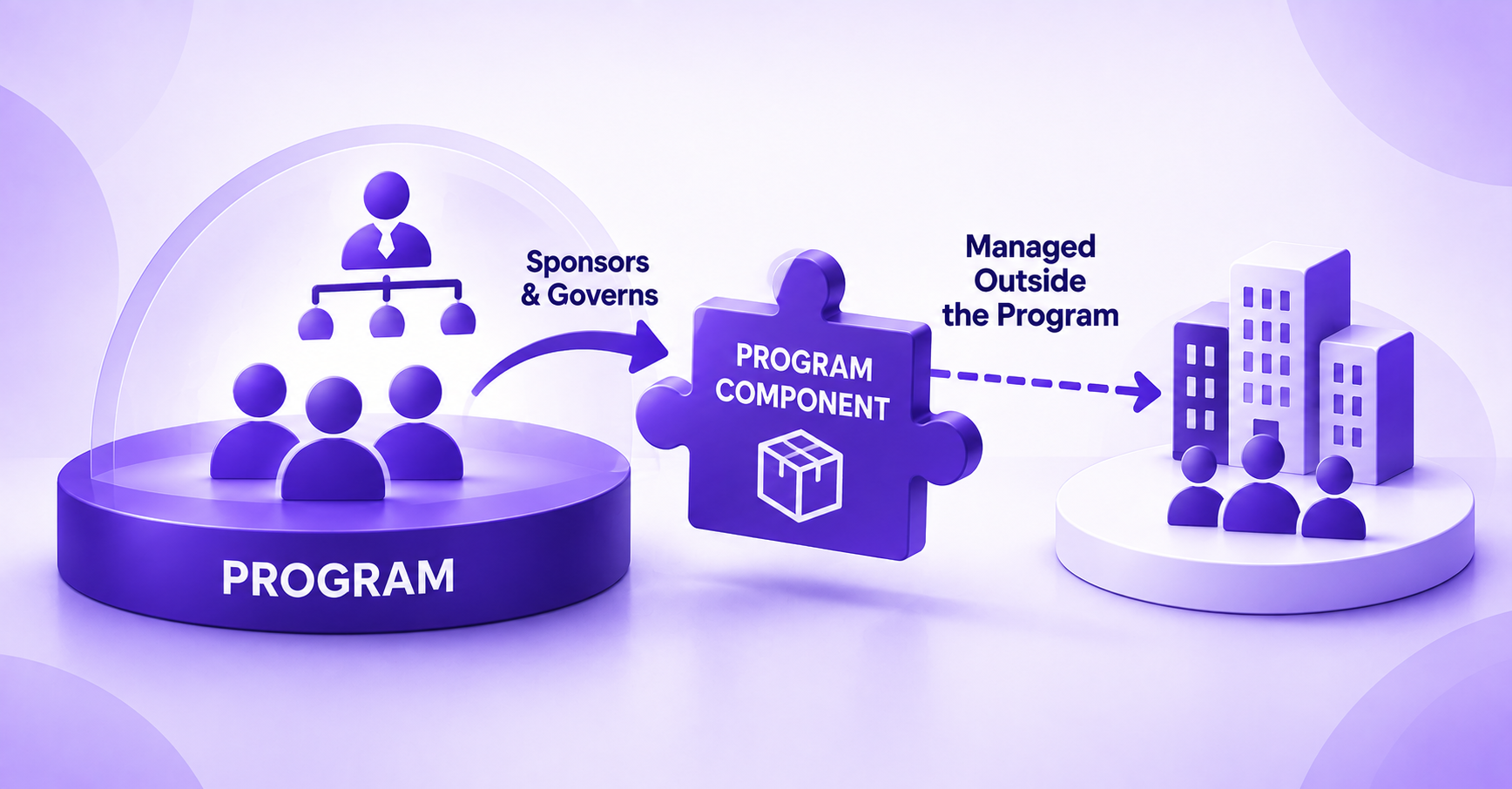
The program could sponsor and govern the component while a specialized event or marketing organization manages its day-to-day execution.
The relationship could look like this:
World Cup Program → Sponsors & Governs → Marketing & Promotion Component → Managed by a Specialized Organization
The external organization may manage campaigns, media, advertising, digital promotion, agencies, and other operational activities.
Meanwhile, the program retains the governance perspective: strategic alignment, major decisions, dependencies, performance oversight, risks, escalations, and ensuring that the component continues to support the program’s objectives and benefits.
The PgMP takeaway
This is where candidates sometimes get confused.
Being a program component doesn’t necessarily mean being directly managed by the program manager.
A component can be managed by another department, business unit, partner, vendor, or specialized organization and still have an important relationship with the program.
What matters is the contribution to program objectives and benefits and the governance relationship with the program.
So when you see a scenario in the PgMP exam saying:
“A component is managed outside the program…”
Don’t immediately conclude that it isn’t a program component.
Look for the bigger picture.
Is it contributing to the program’s objectives?
Are its dependencies and performance connected to the program?
Is there appropriate program governance and oversight?
If yes, external management of the component’s day-to-day work does not, by itself, make it outside the program.
Remember this
A program doesn’t have to manage everything it governs.
That one sentence can help you distinguish governance from day-to-day management and avoid a very common PgMP exam trap.
In the field of project management, professionals utilize various methodologies and approaches to ensure successful project execution and delivery. Two such methodologies, GEMBA and MBWA, play pivotal roles in project management. This article delves into the intricacies of GEMBA and MBWA, highlighting their differences, applications, and significance in project management.
2. What is GEMBA?
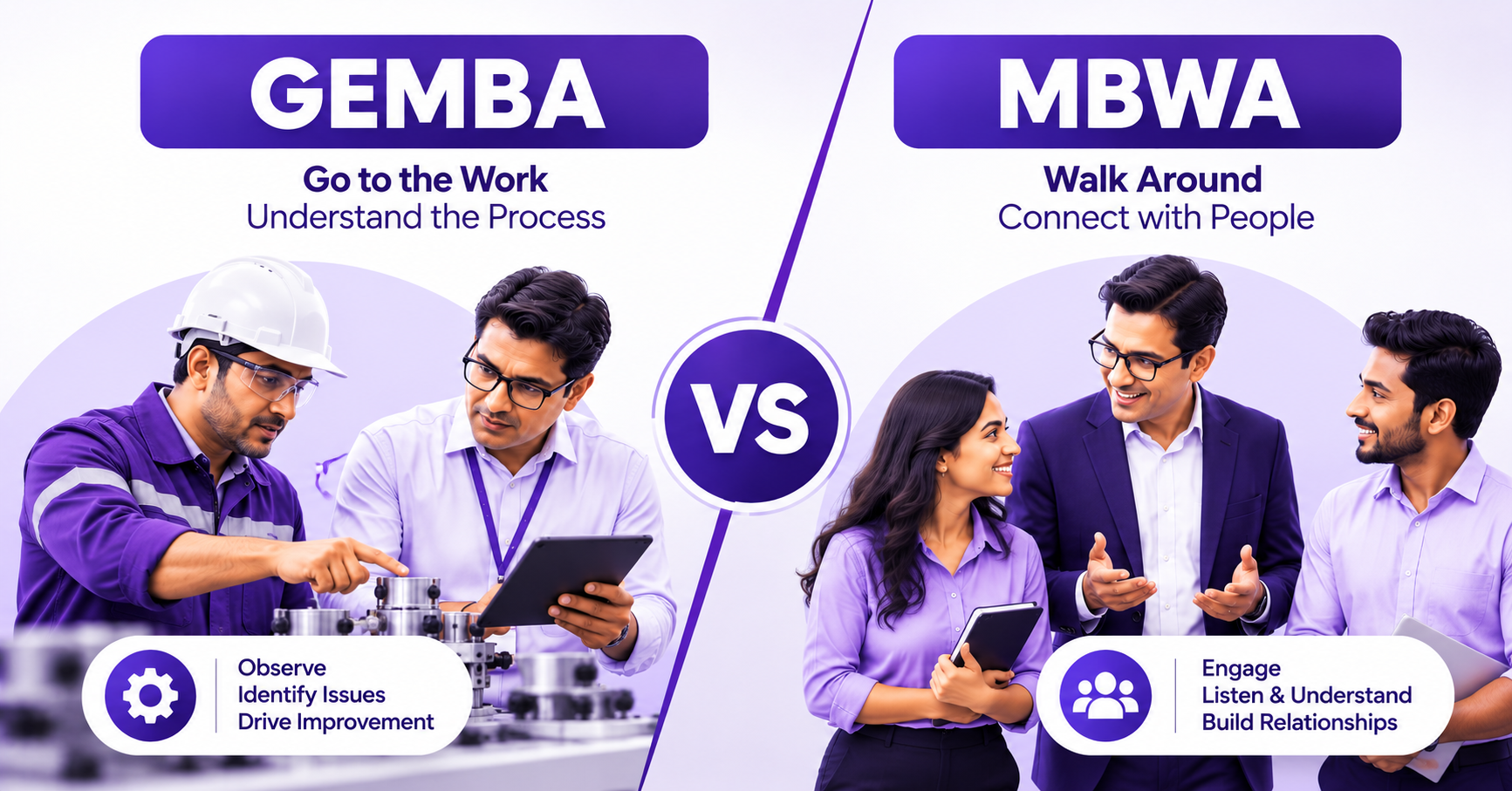
The Gemba Walk involves managers and leaders physically going to the work area to observe, engage with employees, and gain a deeper understanding of the processes and problems firsthand. The primary purpose of the Gemba Walk is to identify opportunities for improvement, recognize potential inefficiencies, gather feedback from employees, and foster a culture of continuous improvement. It allows leaders to see things from the perspective of the employees, encouraging collaboration and a better understanding of day-to-day challenges.
3. What is MBWA?
MBWA (Management by Walking Around): MBWA, on the other hand, is a management style popularized by Tom Peters and Robert Waterman in their book “In Search of Excellence.” It involves managers actively roaming around the workplace, interacting with employees, and engaging in informal conversations. The main idea behind MBWA is for managers to be accessible and approachable, allowing them to stay informed about the organization’s pulse, listen to employees’ concerns, and build better relationships with the team.
4. Comparing GEMBA and MBWA
Unlike the Gemba Walk, MBWA is not solely focused on process improvement or identifying operational inefficiencies. Instead, it emphasizes maintaining an open line of communication and building a positive company culture where employees feel valued, heard, and empowered.
5. GEMBA in Action: Real-World Example
Case Study 1: Improving Efficiency in a Manufacturing Plant
Industry: Automotive Manufacturing
Challenge: A leading automobile manufacturer was facing productivity issues in one of its assembly plants. The production line was experiencing frequent delays and quality defects, resulting in increased costs and dissatisfied customers.
GEMBA Approach: The plant manager decided to implement GEMBA to identify the root causes of the inefficiencies. He spent time on the shop floor, observing the assembly process, talking to workers, and closely examining the production line.
Observations and Findings:
Workers lacked proper training on certain assembly procedures.
Some equipment needed maintenance to function optimally.
The production layout caused bottlenecks and delays.
Communication gaps between different teams were evident.
Action Taken:
Organized comprehensive training sessions for the workers.
Scheduled preventive maintenance for critical equipment.
Redesigned the production layout to improve workflow.
Implemented regular cross-functional meetings to enhance communication.
Results:
The assembly line’s productivity increased by 20%.
Defects and rework decreased by 30%, leading to higher-quality vehicles.
The plant achieved on-time delivery and improved customer satisfaction.
Case Study 2: Enhancing Patient Care in a Hospital
Industry: Healthcare
Challenge: A reputable hospital was facing challenges in patient care, leading to longer waiting times, increased staff burnout, and reduced patient satisfaction.
GEMBA Approach: The hospital’s director of operations decided to adopt GEMBA principles to better understand the care delivery process. She spent time in different departments, including emergency, admissions, and patient wards.
Observations and Findings:
The emergency department experienced frequent overcrowding due to inefficient triage processes.
Nurses and doctors were overwhelmed by administrative tasks, reducing time for patient care.
Communication breakdowns between shifts led to critical information being missed.
Action Taken:
Implemented a more streamlined triage system for the emergency department.
Hired additional administrative staff to assist healthcare providers.
Conducted regular handover meetings to ensure effective communication between shifts.
Results:
Waiting times in the emergency department were reduced significantly.
Healthcare providers reported reduced stress levels and increased focus on patient care.
Patient satisfaction scores improved, reflecting positively on the hospital’s reputation.
6. MBWA in Action: Real-World Example
Case Study 1: Boosting Employee Engagement in a Tech Startup
Industry: Technology
Challenge: A growing tech startup was experiencing a decline in employee engagement and motivation, leading to decreased productivity and high employee turnover.
MBWA Approach: The CEO of the startup decided to adopt MBWA as a means to reconnect with the employees and understand their concerns. She regularly interacted with team members, both individually and in group settings.
Observations and Findings:
Employees felt disconnected from the company’s mission and vision.
Some team members were overwhelmed with their workloads.
A lack of recognition and appreciation affected morale.
Action Taken:
Conducted town hall meetings to communicate the company’s goals and values.
Implemented workload balancing measures and provided resources for skill development.
Introduced an employee recognition program to acknowledge outstanding contributions.
Team members reported feeling more valued and motivated.
The startup experienced a decline in employee turnover and an increase in productivity.
Case Study 2: Improving Team Collaboration in a Marketing Agency
Industry: Marketing and Advertising
Challenge: A marketing agency was facing challenges in cross-team collaboration, leading to missed deadlines and client dissatisfaction.
MBWA Approach: The agency’s director decided to embrace MBWA to foster better teamwork and understand the dynamics between different departments. She actively engaged with team members from various teams, including design, content, and social media.
Observations and Findings:
Team members lacked awareness of each other’s projects and timelines.
Communication between teams was mostly limited to emails and lacked efficiency.
Some team members felt their ideas were not heard or considered.
Action Taken:
Implemented regular cross-team meetings to share project updates and progress.
Introduced a team collaboration platform for easier communication and file sharing.
Conducted brainstorming sessions to encourage input from all team members.
Results:
Collaboration between teams improved, leading to better project coordination.
The agency’s work processes became more streamlined and efficient.
Clients noticed improved deliverables and praised the agency’s collaborative approach.
7. Limitations of GEMBA and MBWA
7.1 Challenges of GEMBA
Time-consuming, especially for large-scale projects.
May face resistance from certain team members.
7.2 Challenges of MBWA
Managers must strike a balance to avoid micromanagement.
May be less effective in remote or virtual team settings.
8. Implementing GEMBA and MBWA in Projects
8.1 Steps of Successful Implementation
Educate the team about the methodologies.
Set clear objectives and expectations.
Allocate sufficient time and resources for implementation.
8.2 Overcoming Resistance to Change
Involve team members in the decision-making process.
Showcase the potential benefits of GEMBA and MBWA.
9. The Future of GEMBA and MBWA in Project Management
As project management continues to evolve, GEMBA and MBWA are likely to remain relevant for their unique contributions to success.
10. Conclusion
In conclusion, while both Gemba Walk and MBWA involve managers physically moving around the workplace to interact with employees, the key difference lies in their primary objectives. Gemba Walk is focused on process improvement and continuous learning, while MBWA centers on building relationships, employee engagement, and fostering a positive work environment.
11. FAQs
Q: Can GEMBA and MBWA be used simultaneously in a project?
A: Yes, project managers can integrate both methodologies to gain comprehensive insights and maintain strong team collaboration.
Q: What industries benefit the most from using GEMBA and MBWA?
A: GEMBA and MBWA can benefit industries like manufacturing, healthcare, construction, and software development.
Q: Is GEMBA suitable for remote project management?
A: GEMBA’s effectiveness may be limited in remote settings, but some aspects can still be applied through virtual communication channels.
Q: How can I convince team members to embrace GEMBA and MBWA?
A: Showcasing successful case studies and explaining the potential benefits can help overcome resistance to change.
Q: Where can I learn more about implementing GEMBA and MBWA?
A: Numerous resources, books, and online courses provide detailed insights into the practical application of GEMBA and MBWA in project management.
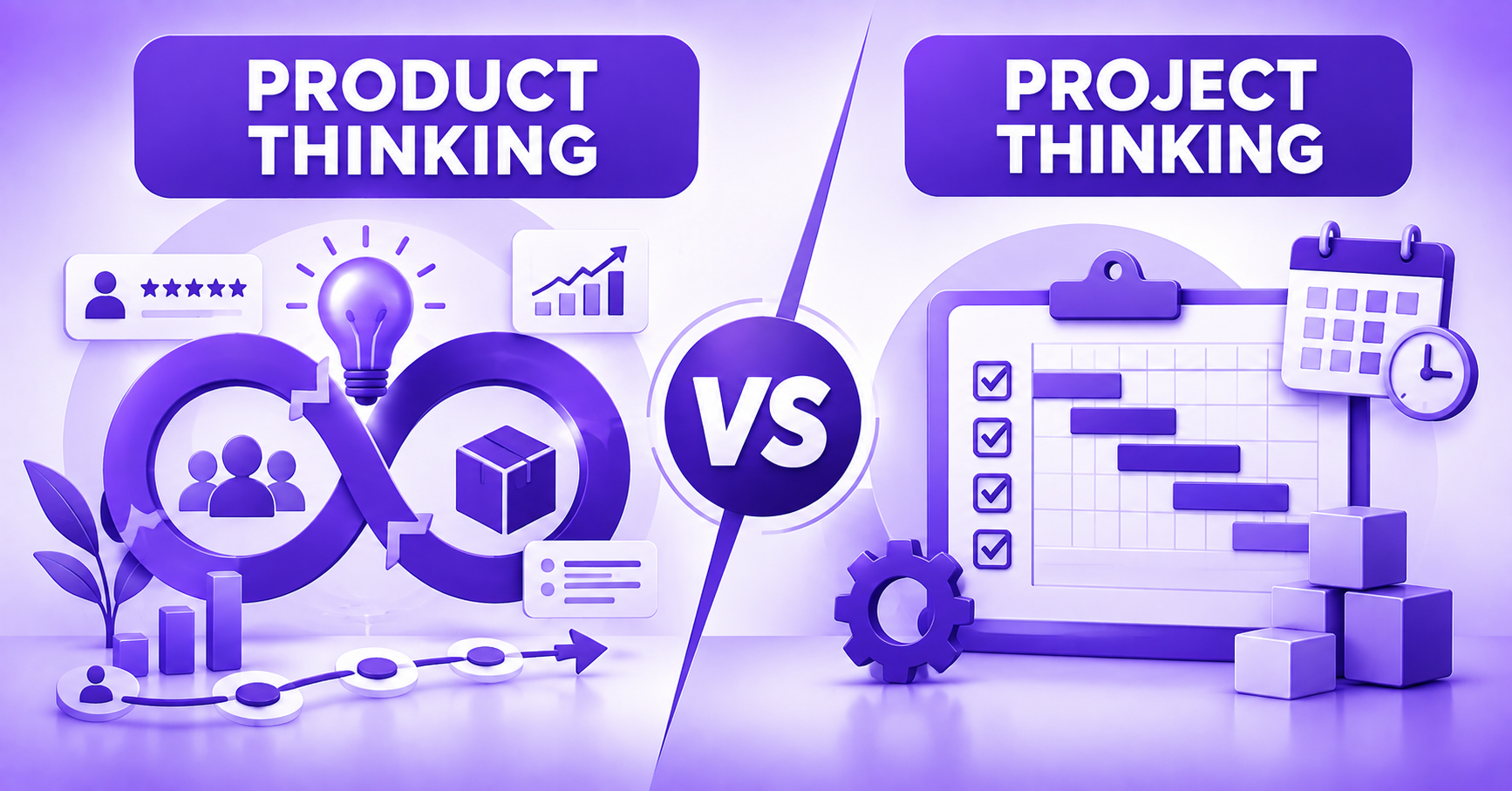
Product Thinking is an approach that emphasizes the long-term vision and continuous value delivery of a product. It focuses on understanding customer needs, solving their problems, and creating a product that evolves and adapts over time. In this mindset, we view the development of our product as an ongoing journey with no fixed end date. We aim to provide the best possible experience to our customers by delivering incremental improvements and features that align with their changing requirements.
2. What is Project Thinking
Project Thinking, on the other hand, is a more traditional approach where the development process is structured as a temporary endeavor with a fixed scope, timeline, and budget. The project team divides the process into stages, like design, prototyping, testing, and production. Each stage has its objectives and deadlines, ensuring a systematic approach to the entire project. Once the project’s objectives are met, it is considered complete, and the team moves on to the next project.
3. Balancing Both Approaches
To succeed in today’s business landscape, you must strike a balance between product thinking and project thinking. While product thinking ensures the product meets customer needs and remains competitive in the market, project thinking ensures timely execution and cost control.
4. Benefits of Embracing Product Thinking
4.1 Enhanced Customer Satisfaction
By prioritizing customer needs and preferences, the products developed with a product thinking approach are more likely to exceed expectations. This focus on customer satisfaction can lead to higher customer loyalty and positive brand reputation
4.2 Adaptability to Market Changes
Today every industry experiences rapid technological advancements and changing market dynamics. Product thinking allows companies to adapt to these changes proactively, ensuring their products remain relevant and competitive.
4.3 Sustainable Growth
A product-centric approach fosters long-term planning and strategic decision-making. This can lead to sustained growth, as the company consistently offers products that cater to the evolving needs of its customers.
5. Advantages of Adopting Project Thinking
5.1 Clear Milestones and Deadlines
Project thinking enables clear identification of milestones and deadlines. This level of clarity helps the team stay focused, motivated, and accountable throughout the project’s lifecycle.
5.2 Efficient Resource Allocation
By breaking down the project into manageable phases, project thinking allows for efficient resource allocation. Teams can allocate resources where they are needed the most, optimizing productivity and minimizing waste.
5.3 Measurable Success
Project thinking facilitates the measurement of project success at each stage. This helps in identifying areas of improvement and allows for data-driven decision-making.
6. Creating Synergy between Approaches
Successful companies understand the importance of integrating product and project thinking seamlessly. By fostering collaboration between product managers and project managers, companies can align their objectives and work towards common goals.
7. Challenges in Implementing Product and Project Thinking
7.1 Overcoming Resistance to Change
Implementing product and project thinking may face resistance from individuals comfortable with traditional approaches. Overcoming this resistance requires effective change management and clear communication about the benefits of the new mindset.
7.2 Balancing Long-Term and Short-Term Objectives
Balancing long-term product vision with short-term project milestones can be challenging. You must help your teams prioritize tasks while keeping the overall product strategy in mind.
7.3 Aligning Team Mindsets
Product and project teams may have different perspectives and priorities. Aligning these mindsets towards a common goal requires effective leadership and a shared understanding of the organization’s vision.
8. Conclusion
In conclusion, grasping the nuances of product thinking and project thinking is crucial for the success of your projects. While product thinking ensures customer-centricity and long-term vision, project thinking brings structure and efficiency to the development process. By integrating these approaches harmoniously, companies can build innovative and market-leading products while meeting project objectives with precision.
That’s all in this article. Once again, thank you for being part of this weekly newsletter series. I kindly ask for your continued support. Liking, sharing, and subscribing to this newsletter series is a simple yet powerful way to show your appreciation. By doing so, you not only help me reach a wider audience but also contribute to building a thriving community of knowledge seekers and enthusiasts.
A PgMP aspirant recently asked me a deceptively simple question:
“Should the Program Roadmap be developed only after the Program Charter is approved?”
My answer was:
Not necessarily.
And this is where understanding program management as a practitioner becomes more important than memorizing a sequence of documents.
At first glance, the sequence appears straightforward:
Business Case → Program Charter → Program Roadmap → Program Management Plan
After all, the Program Charter formally authorizes the program. So why would we develop a roadmap for a program that hasn’t even been authorized yet?
Good question.
But the reality is more nuanced.
What does the PMI Standard tell us?
The Standard for Program Management, Fifth Edition establishes an important sequence.
The business case comes first and provides the justification for the investment. Following approval of the business case, the Program Charter is presented to the appropriate governance authority for approval, funding, and authorization.
And the Charter itself already contains quite a lot of high-level information.
It includes the program’s goals and objectives, benefits, dependencies, high-level risks, resources and, importantly for our discussion, the overall program timeline and key milestone dates.
The Standard then describes the Program Roadmap as a major component of the Program Management Plan. It graphically and chronologically represents the program’s intended direction, including major milestones, decision points, dependencies and the connection between organizational strategy and program work.
So it would be very easy to conclude:
“Fine. Charter gets approved first. Then I develop the Roadmap.”
But don’t stop there.
Because the PgMP Examination Content Outline (ECO) gives us another important clue.
The ECO changes how you should think about the sequence
Look carefully at Domain I: Strategic Program Alignment.
One of the tasks (task # 2) of the program manager is to:
Establish a high-level roadmap with milestones and preliminary estimates to obtain initial validation and approval from the executive sponsor.
The very next task (task # 3) further develops that high-level roadmap and financial framework as a baseline for program definition, planning and execution.
And later, the ECO expects (task # 09) the program manager to obtain organizational leadership approval by presenting the Program Charter with its high-level costs, milestone schedule and benefits.
That wording matters.
The high-level roadmap isn’t always something that magically appears after authorization.
Sometimes you need enough of a roadmap to make authorization possible.
Think of it as two levels of maturity
This is the distinction I want my PgMP learners to remember:
Pre-authorization: High-Level Roadmap
Strategic direction. Major milestones. Preliminary estimates. Major dependencies. Broad sequencing. Enough information for executives to understand:
“If we authorize this program, what does the journey roughly look like?”
Then comes:
Program Charter Approval
The governance authority formally authorizes the program and gives the program manager authority to proceed.
And after authorization:
Elaborated Program Roadmap
Now the roadmap can progressively mature as the program is planned, components become clearer, dependencies are better understood and the benefits realization path becomes more concrete.
This isn’t contradictory.
It is progressive elaboration at the program level.
In fact, the Standard itself recognizes that program formulation is not a neat document-by-document waterfall. During formulation, the sponsor, sponsoring organization and program manager work together on estimates of scope, resources and cost, initial high-level assessments, the Program Charter and milestones. The Charter then becomes the primary document used to decide whether the program should be authorized. So don’t confuse formal authorization with the first time thinking about the program’s path.
Those are two very different things.
Now think like a PgMP exam candidate
Suppose you get this question:
A proposed strategic program involves several interdependent components and significant investment. The executive sponsor wants to understand major milestones, preliminary estimates and the expected path toward benefits before providing initial approval. What should the program manager develop?
Don’t choose the detailed Program Management Plan.
Don’t jump to the Program Master Schedule.
And don’t argue that a roadmap cannot exist because the Charter hasn’t yet been approved.
The best answer is:
Establish the high-level Program Roadmap.
Why?
Because the ECO explicitly associates the high-level roadmap, milestones and preliminary estimates with obtaining initial validation and approval from the executive sponsor.
Now change the question slightly:
Organizational leadership has reviewed the proposed program’s objectives, high-level costs, milestone schedule and expected benefits. What should the program manager seek next to formally initiate the program?
Now your answer shifts to:
Approval of the Program Charter.
Because authorization comes through the Charter.
That’s the kind of distinction the PgMP exam expects you to recognize.
The mentor’s takeaway
Don’t memorize this as:
Charter first. Roadmap second.
That’s too simplistic.
Instead, understand it this way:
A high-level roadmap can support the decision to authorize the Program Charter. After authorization, the roadmap is progressively elaborated and becomes an important part of planning and ongoing strategic alignment.
The Standard for Program Management itself says that during the Program Definition phase, the business case, Program Charter and Program Roadmap are formulated, and only after approval is the Program Management Plan prepared.
That one statement should make us cautious about treating these artifacts as a rigid waterfall.
Program management isn’t:
Finish Document A → lock it → create Document B → lock it → create Document C.
It’s an iterative process of turning strategic intent into an increasingly credible path toward benefits.
And sometimes, before an executive can say:
“I authorize this program.”
they first need to see:
“Show me how you believe we’re going to get there.”
That is where the high-level Program Roadmap becomes powerful.
PgMP Exam Lens
When you see initial validation, major milestones, preliminary estimates and executive sponsor approval, think:
High-Level Program Roadmap.
When you see formal authorization, authority to use organizational resources and authorization to initiate the program, think:
Program Charter.
When you see detailed integration of components, subsidiary plans and management controls, think:
Program Management Plan.
Understanding those boundaries will help you far more on the PgMP exam than memorizing a sequence.
One concept that is consistently overlooked by many Program Managers is the difference between Critical Success Factors (CSFs), Performance Measurement Criteria, and Key Performance Indicators (KPIs).
Many professionals use these terms interchangeably because they appear closely related. However, they serve three completely different purposes.
Understanding this distinction isn’t just important for passing the PgMP examination. More importantly, it helps Program Managers build an effective performance management framework that enables better governance, informed decision-making, and successful benefits realization.
Let’s understand this through a simple marathon example.
Imagine you’re preparing to run a marathon.
Your objective is straightforward.
Successfully complete the marathon.
Now ask yourself three simple questions.
Question 1
What must go right for me to succeed?
Some of the Critical Success Factors (CSFs) could be:
Consistent adherence to the training plan.
Proper nutrition and hydration throughout the preparation period.
Adequate sleep and recovery throughout training.
Remaining injury-free until race day.
Maintaining discipline and motivation throughout the journey.
Notice something important.
These are not measurements.
They are the conditions and practices that significantly increase the probability of success.
These are your Critical Success Factors (CSFs).
Question 2
What aspects of my preparation and performance should I evaluate?
Now you’re no longer asking what must go right.
Instead, you’re asking what areas should be evaluated to understand whether you’re progressing toward your objective.
Some Performance Measurement Criteria could be:
Training adherence
Physical fitness
Endurance
Running speed
Physiological recovery
Notice that these are still not measurements.
They are the dimensions in which performance will be evaluated.
These become your Performance Measurement Criteria.
Question 3
How will I objectively measure these areas?
Now it’s time to define the Key Performance Indicators (KPIs).
Performance Measurement Criterion
Key Performance Indicator (KPI)
Training Adherence
Complete at least 95% of scheduled training sessions
Physical Fitness
Resting heart rate remains within the target range
Endurance
Complete a continuous 30 km training run before race day
Running Speed
Complete a 5 km run in under 25 minutes
Physiological Recovery
Heart rate returns to the target recovery zone within the expected time after a long run
Now you’re measuring performance objectively.
The Relationship
The easiest way to remember these concepts is:
Objective
↓
Critical Success Factors
What must go right?
↓
Performance Measurement Criteria
What will I evaluate?
↓
Key Performance Indicators
What exactly will I measure?
↓
Monitoring
↓
Corrective Actions
↓
Success
Why This Matters in Program Management
Many organizations begin by defining KPIs.
They immediately start measuring schedule variance, cost variance, resource utilization, productivity, or dozens of other metrics.
But here’s the problem.
If the Critical Success Factors haven’t been identified first, teams often end up measuring activities that have very little influence on the overall success of the program.
Similarly, if Performance Measurement Criteria haven’t been clearly defined, KPIs become isolated numbers that provide little insight into the actual health of the program.
An experienced Program Manager follows a much more logical sequence.
First, identify what must go right.
Then determine what aspects of the program should be evaluated.
Only then define the measurable indicators that objectively demonstrate performance.
This creates a performance management framework that supports better governance, timely corrective actions, informed decision-making, and ultimately, successful benefits realization.
Frequently Asked Questions
Even after understanding the relationship between Critical Success Factors, Performance Measurement Criteria, and Key Performance Indicators, a few practical questions often arise. These are some of the most common questions I receive from Program Managers and PgMP aspirants during mentoring sessions.
1. Can one Critical Success Factor have multiple KPIs?
Yes, and in many cases, it should.
A single Critical Success Factor often needs to be evaluated from multiple perspectives.
For example:
Critical Success Factor
Maintain excellent physical fitness.
Performance Measurement Criteria
Physical fitness.
Possible KPIs
Resting heart rate within the target range.
Body fat percentage within the desired range.
VO₂ Max above the target level.
One success factor may therefore be supported by several KPIs that collectively provide a more complete picture of performance.
2. What is the biggest mistake organizations make while defining KPIs?
The biggest mistake is measuring everything instead of measuring what matters.
More KPIs do not necessarily improve performance.
In fact, too many KPIs often create confusion, dilute management attention, and make decision-making more difficult.
An experienced Program Manager identifies the few measures that best indicate whether the program is progressing toward its intended strategic outcomes.
3. Can Critical Success Factors, Performance Measurement Criteria, and KPIs change during the program lifecycle?
Absolutely.
Programs operate in dynamic environments. Strategic priorities, market conditions, regulations, stakeholder expectations, and organizational objectives may evolve over time.
When significant changes occur, the Program Manager should reassess:
Whether the existing Critical Success Factors are still relevant.
Whether the Performance Measurement Criteria continue to reflect the areas that matter most.
Whether the KPIs still provide meaningful insights into program performance.
Performance management is not a one-time planning activity. It is continuously reviewed and refined to ensure the program remains aligned with organizational strategy and continues to deliver the intended business benefits.
4. Should every constituent project have the same KPIs?
Not necessarily.
Each constituent project may have its own project-specific KPIs based on its scope, objectives, and deliverables. However, the Program Manager should establish standard program-level measurement criteria so that performance can be evaluated consistently across all constituent projects.
Think of it this way:
Project KPIs measure whether an individual project is successful.
Program KPIs measure whether the combined outcomes of all projects are achieving the program’s strategic objectives and expected business benefits.
This distinction is particularly important for the PgMP exam because PMI expects Program Managers to think beyond individual project performance.
🚀 Ready for Career Transformation?
PgMP® is not just a certification. It’s a career transformation.
That transformation happens when you learn the right concepts, apply them in real-world programs, and develop the mindset of a strategic Program Manager. That’s exactly what our Group Mentoring Program is designed to help you achieve.
If you’re ready to earn your PgMP and transform your career, join our next cohort.
Completing the deliverables doesn't complete the program. Transitioning and sustaining the benefits does.
Imagine you are the Program Manager for Green Horizon Township, a premium residential township developed under a Build-Operate-Transfer (BOT) model.
The program delivers:
🏢 Eight residential towers
🏥 200-bed hospital
🏫 Secondary school
🏡 Clubhouse
🛍️ Shopping complex
🏟️ Sports arena
🌳 Community park
🏛️ Civic centre
After several years of execution, every component has been successfully completed.
Construction is over.
Quality inspections have been signed off.
Occupancy certificates have been obtained.
At this stage, many professionals would confidently say,
“The program is complete.”
Not quite.
From a PgMP perspective, completing the construction is only the beginning of realizing benefits.
The next question every Program Manager should ask is:
“Is the organization ready to take ownership of these benefits, and can those benefits continue delivering value for years to come?”
The answer to these two questions explains one of the most frequently tested concepts in the PgMP examination: Benefit Transition and Benefit Sustainment.
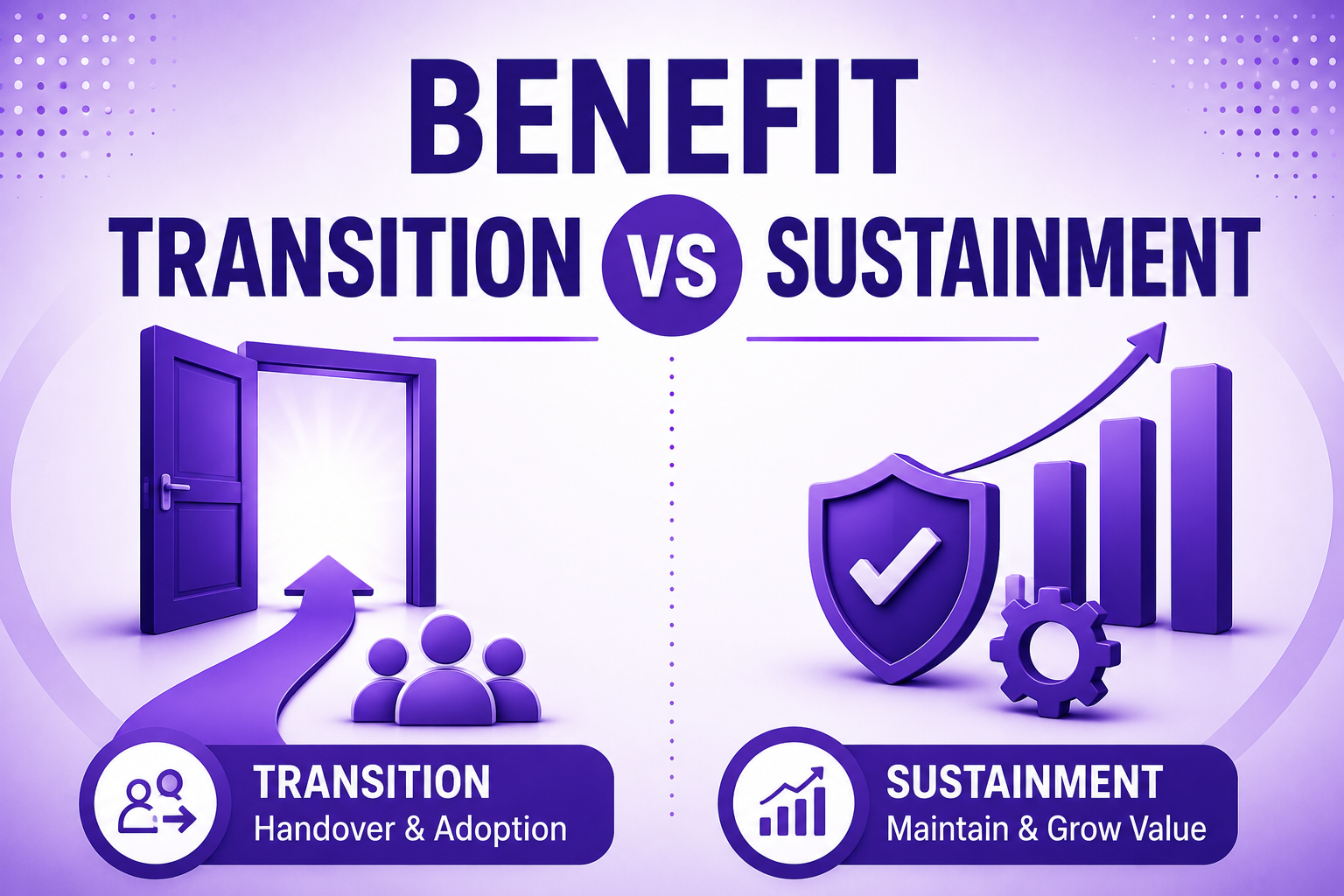
🔄 Benefit Transition
“Can the receiving organization now take ownership of the delivered benefits?”
Once the township satisfies its acceptance criteria, the Program Manager executes Benefit Transition.
Benefit Transition is not simply a planning activity.
It is the actual handover of the completed capability to the organization that will operate it.
Typical transition activities include:
✅ Operational readiness assessment
✅ Acceptance verification
✅ Training operational staff
✅ Transfer of manuals and documentation
✅ Warranty transfer
✅ Municipal approvals
✅ Residual risk transfer
✅ Formal handover and acceptance
Benefit Transition = Executing the transfer of the delivered capability to the receiving organization so benefits can be sustained.
👨💼 Program Manager’s Responsibilities
✔ Verify benefit realization criteria have been achieved.
✔ Confirm operational readiness.
✔ Coordinate handover across all program components.
✔ Ensure documentation, contracts, training, and risks are transferred.
✔ Obtain formal acceptance from the receiving organization.
🌱 Benefit Sustainment
“Can the organization continue realizing these benefits for years to come?”
After successful transition, residents begin occupying Green Horizon Township.
The township is now operated through Operations Portfolio, which performs:
🏢 Building maintenance
🧹 Housekeeping
🛡️ Security
🌳 Landscaping
⚡ Utility management
😊 Customer satisfaction monitoring
These are Benefit Sustainment activities.
The Program Manager doesn’t run day-to-day operations.
Instead, the Program Manager ensures, before program closure, that the receiving organization is fully prepared to sustain the benefits.
👨💼 Program Manager’s Responsibilities
✔ Develop the Benefits Sustainment Plan.
✔ Define operational KPIs.
✔ Identify sustainment risks.
✔ Assign benefit ownership.
✔ Ensure the receiving organization is capable of sustaining the benefits.
💎 Benefit vs Business Value
Another concept frequently confused in the PgMP exam is the difference between Benefits and Business Value.
For Green Horizon Township:
Benefits
Once the township becomes operational:
🏥 Patients receive healthcare.
🏫 Students attend school.
🏢 Residents occupy their homes.
🛍️ Businesses begin serving customers.
These are benefits being realized.
Business Value
As these benefits continue over time, the organization begins achieving its strategic objectives.
For example:
📈 Increased property appreciation
💰 Sustainable rental and commercial revenue
😊 Higher resident satisfaction
🏆 Enhanced brand reputation
📊 Better return on investment
🎯 Long-term strategic growth
These outcomes represent the business value created through sustained benefit realization.
Benefits answer:“What positive outcome has been achieved?”
Business Value answers:“How do those outcomes help achieve the organization’s strategic objectives?”
Understanding the difference between Benefits and Business Value explains what the Program Manager is trying to achieve.
The next question is equally important…
When should the Program Manager start preparing for Benefit Transition and Benefit Sustainment?
The answer is much earlier than most PgMP aspirants expect.
📅 When are these plans prepared?
This is where many PgMP aspirants get confused.
The Benefits Transition Plan and Benefits Sustainment Plan are developed and progressively refined during the Program Delivery Phase as components mature and approach operational readiness.
They are executed only when the delivered capability is ready for transition.
If the program delivers incremental benefits, there may be:
🔹 Multiple Benefit Transition Plans
🔹 Multiple Benefit Sustainment Plans
🔹 Multiple transition events
Each completed capability can have its own transition event and corresponding sustainment activities. PMI explicitly recognizes that there may be multiple transition events as individual program components close and that incremental benefits may be transitioned before the overall program ends.
📊 Benefit Transition vs Benefit Sustainment
Benefit Transition
Benefit Sustainment
Transfers ownership
Maintains business value
Executed after a capability is completed
Continues after transition and often after program closure
Program Manager leads the transition
Receiving organization performs the sustainment
Focuses on acceptance and operational readiness
Focuses on ongoing operational performance
Tactical execution using transition checklists
Operational execution using sustainment processes
🎯 PgMP Exam Nuggets
💡 Transition is about “Readiness.”
💡 Sustainment is about “Continuity.”
💡 The Program Manager owns the transition but not the day-to-day operations.
💡 A Transition Plan is prepared before handover. The handover itself is the Benefit Transition.
💡 A Sustainment Plan is prepared before program closure, but sustainment activities continue after transition and frequently after program closure.
💡 Programs delivering incremental benefits can have multiple transition plans, multiple sustainment plans, and multiple transition events.
Remember this one line for the PgMP exam: Benefit Transition delivers ownership. Benefit Sustainment preserves value.
When people think about portfolio management, they often picture a collection of active projects, programs, and transformation initiatives working together to execute strategy.
But here’s a question that often surprises even experienced practitioners:
Can a portfolio continue to exist when there are no active projects or programs – only business operations?
The answer is yes.
More importantly, sometimes that is exactly what an organization should do.
The real purpose of portfolio management is not to maximize the number of initiatives. Its purpose is to maximize strategic value. And occasionally, the best strategic decision is to pause launching new change initiatives.
A Strategic Pause Is Not Portfolio Failure
An operations-only portfolio doesn’t automatically signal poor planning or a lack of innovation. In mature organizations, it may represent a deliberate governance decision made after evaluating strategy, organizational capacity, market conditions, and investment priorities.
Think of it as a pilot holding an aircraft in a safe pattern before landing. The aircraft is still flying, fully controlled, and continuously monitored. It’s simply waiting for the right conditions.
Similarly, a well-governed portfolio may intentionally enter a temporary holding pattern while preserving operational value.
When Does This Happen?
Several business situations can legitimately create an operations-only portfolio.
Strategic Realignment
Leadership may be redefining strategic objectives following a merger, market disruption, leadership transition, or major policy shift. Rather than approving initiatives against an uncertain strategy, organizations wisely pause new investments while continuing business operations.
Completion of a Strategic Investment Cycle
Every portfolio experiences natural peaks and valleys. After completing a significant transformation program, organizations often take time to stabilize operations, measure benefits, capture lessons learned, and validate outcomes before committing to the next investment cycle.
Portfolio Rebalancing
Economic uncertainty, regulatory changes, budget constraints, or changing customer expectations may require executives to defer or cancel planned initiatives. During this period, governance focuses on protecting organizational value while preparing the next investment roadmap.
Organizational Readiness
Sometimes the organization itself needs time.
Teams may require capability development, technology modernization, resource recovery, or cultural adaptation before absorbing another wave of strategic change.
Launching additional initiatives too early often destroys value instead of creating it.
The Critical Difference: Strategic Pause vs Portfolio Stagnation
This is where experienced portfolio managers distinguish themselves.
A strategic pause has:
✔ Executive sponsorship
✔ Clear business rationale
✔ Defined review checkpoints
✔ Active governance
✔ Ongoing strategic assessments
✔ Preparation for future investments
Portfolio stagnation, on the other hand, is characterized by:
❌ No investment pipeline
❌ No strategic review
❌ Governance becoming administrative rather than strategic
❌ Resources gradually losing capability
❌ Missed market opportunities
The difference is not the absence of projects.
The difference is whether leadership is intentionally preparing for the future.
What Should Portfolio Leaders Focus On?
During an operations-only phase, the portfolio manager’s role becomes even more strategic.
Instead of managing delivery, attention shifts toward preparing the organization for its next wave of value creation.
Key priorities include:
Communicate the Intent
Ensure executives, sponsors, and stakeholders understand that this is a deliberate strategic decision rather than organizational inactivity.
A pause should never become an excuse to stop scanning the business environment.
Keep Governance Active
Portfolio governance should remain fully operational through review boards, investment discussions, benefits monitoring, risk oversight, and strategic decision-making.
Governance exists to guide strategic investments—not merely to oversee active projects.
Measure Operational Value
Operations continue delivering measurable business outcomes.
Monitor operational performance, customer value, financial contribution, and strategic alignment to ensure existing investments continue supporting organizational objectives.
Maintain an Investment Pipeline
One of the biggest mistakes during a strategic pause is allowing the future pipeline to disappear.
Continue evaluating opportunities, building business cases, assessing emerging technologies, and prioritizing potential investments so the organization can respond quickly when conditions become favorable.
A Lesson for PfMP Aspirants
This scenario highlights one of the most misunderstood aspects of portfolio management.
Portfolio management is not project management at a larger scale.
Projects deliver outputs.
Programs deliver benefits.
Portfolios enable strategic decision-making.
Even when no projects are running, the portfolio still performs one of its most important responsibilities – determining when not to invest.
Sometimes, choosing not to launch a project is the decision that creates the greatest long-term value.
That is strategic portfolio leadership.
Final Thoughts
An operations-only portfolio should never be viewed in isolation.
The real question isn’t:
“Are there active projects?”
The better question is:
“Is the portfolio continuously enabling the organization to make better strategic investment decisions?”
If the answer is yes, the portfolio is fulfilling its purpose – even during periods of strategic pause.
Because mature portfolio management isn’t measured by how busy the organization is.
It’s measured by how wisely it invests.
Reflection for Leaders
Have you ever intentionally paused new strategic initiatives to strengthen organizational readiness or reassess strategic priorities?
Looking back, did that decision accelerate future success – or create unintended consequences?
I’d love to hear your experiences. Your insights may help fellow portfolio leaders navigate similar situations.
The 20-Minute Debate That Changed the Way Our PgMP Cohort Looked at Program Closure
Last weekend, during one of our live PgMP mentoring sessions, I asked the cohort what I thought was a simple question.
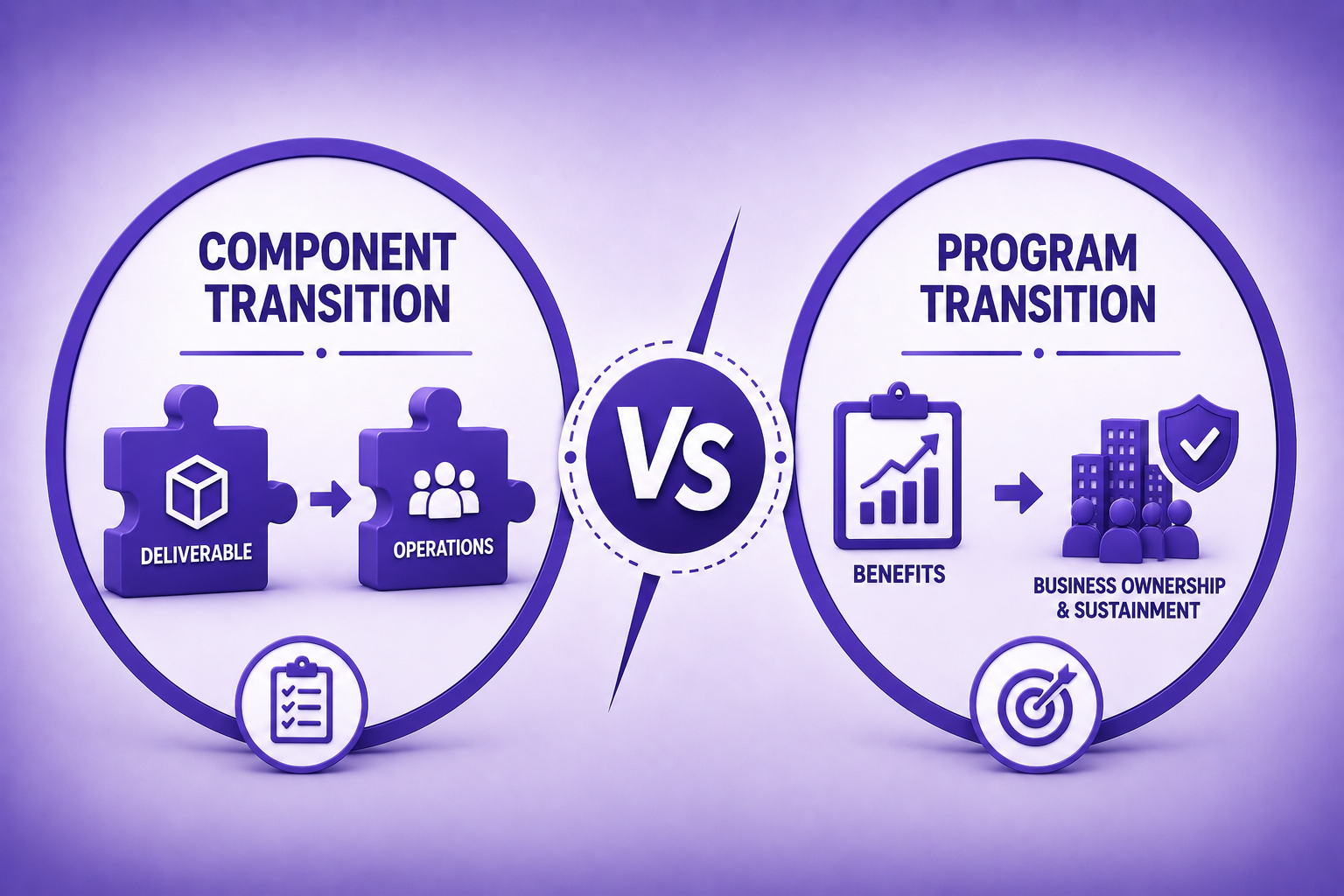
“What’s the difference between Component Transition and Program Transition?”
I expected someone to answer in less than a minute.
Instead, it became one of the most engaging discussions of the entire session.
One participant confidently said,
“Component Transition and Program Transition are essentially the same. Both are about handing over work to Operations.”
Almost immediately, another participant challenged that view.
“No. Component Transition happens during Program Delivery, while Program Transition happens during Program Closure.”
Then another voice joined the conversation.
“If Operations has already accepted all the deliverables, hasn’t the Program already transitioned?”
Within minutes, the session turned into a healthy debate.
Everyone had valid arguments.
Everyone was drawing from their own professional experience.
And that’s exactly what made the discussion so valuable.
By the end of the session, one thing became clear.
The confusion wasn’t about when the transition happens.
The confusion was about what is actually being transitioned.
That single realization completely changed the way everyone looked at this topic.
Since this discussion resonated so strongly with the cohort, I thought it would be worthwhile to share it with the larger PgMP and Program Management community.
PMI Deliberately Treats Them as Two Different Activities
One of the first things we did during the session was open The Standard for Program Management (Fifth Edition).
The answer was sitting right there in the Program Life Cycle.
PMI doesn’t treat Component Transition and Program Transition as interchangeable terms.
In fact, they appear in two different phases of the Program Life Cycle.
Component Transition and Closure take place during the Program Delivery phase.
Program Transition takes place during the Program Closure phase.
That separation is intentional.
Because they serve two completely different purposes.
The Question That Changed the Discussion
Instead of asking,
“When does the transition happen?”
we started asking,
“What exactly is being transitioned?”
Suddenly, everything became much clearer.
Understanding Component Transition
Imagine your organization is executing a Digital Banking Program.
The program consists of several projects.
Mobile Banking Application
Internet Banking Platform
Fraud Detection System
Customer Authentication Solution
The Mobile Banking project completes first.
The application is deployed.
Users are trained.
Production support documentation is complete.
The Operations team formally accepts responsibility for running the application.
Has something been transitioned?
Absolutely.
The project has successfully transitioned its capability to Operations.
This is Component Transition.
Notice something important.
The overall program hasn’t finished.
Other projects are still underway.
Benefits are still emerging.
Dependencies are still being managed.
The Program Manager is still actively leading the program.
In other words…
A component can transition successfully while the program continues.
So What Is Program Transition?
This is where the discussion became even more interesting.
One participant asked,
“If every component has already transitioned successfully, what’s left to transition?”
That’s a brilliant question.
Because Program Transition is not another technical handover.
It is the transition of the program itself.
By the time Program Transition occurs…
The organization is no longer asking,
“Can we operate this solution?”
Instead, it is asking,
“Can we continue realizing the intended benefits without the Program Team?”
That is a completely different question.
Think Beyond Deliverables
Projects deliver products.
Programs deliver strategic value.
A project may successfully hand over a CRM system.
A Program Manager wants to know whether that CRM system is actually improving customer retention, increasing sales productivity, and delivering the business benefits that justified the investment.
Those benefits don’t automatically appear because the software has gone live.
Someone within the business must now own them.
That ownership is established during Program Transition.
The Simplest Way to Remember It
Component Transition
Program Transition
Occurs during Program Delivery
Occurs during Program Closure
Focuses on individual project outputs and capabilities
Focuses on sustaining program benefits and organizational value
Receiving team accepts operational responsibility for a component
Business assumes ownership of ongoing benefits and value realization
Technical and operational readiness
Strategic and business readiness
Here’s the Trap PMI Likes to Set
Imagine this PgMP exam scenario.
Every project within the program has been completed successfully.
All deliverables have been accepted.
Training has been completed.
Support teams have taken over.
The sponsor now recommends closing the program immediately.
Would you agree?
A Project Manager might.
A Program Manager pauses.
Before recommending Program Closure, the Program Manager asks questions such as:
Have benefit owners formally accepted responsibility?
Is governance for ongoing benefits established?
Can Operations sustain the new capabilities?
Has the organization accepted ownership of long-term value realization?
Those questions belong to Program Transition.
Not Component Transition.
The Insight That Stayed With the Cohort
Toward the end of the discussion, one participant summarized the entire concept in a single sentence.
“Component Transition makes the solution operational. Program Transition makes the organization responsible for the value.”
I couldn’t have said it better myself.
My PgMP Exam Tip
Whenever you read a PgMP question, don’t immediately focus on the word transition.
Instead, ask yourself one question.
What is actually being transitioned?
If the scenario is talking about an individual project, its deliverables, or operational capability…
Think Component Transition.
If the scenario is talking about benefits, business ownership, governance, organizational readiness, or sustaining long-term value…
Think Program Transition.
That single distinction can eliminate two incorrect options before you even start evaluating the remaining answers.
Final Thoughts
One of the biggest mindset shifts in becoming a successful Program Manager is realizing that programs are never created simply to deliver projects.
They exist to create lasting organizational value.
Projects may complete.
Deliverables may be accepted.
Components may transition.
But a Program should only transition when the organization is truly prepared to sustain the intended benefits long after the Program Team has stepped away.
And perhaps that’s the simplest way to remember the difference.
Component Transition is about making the solution operational.
Program Transition is about making the value sustainable.
🚀 Ready to Take Your PgMP Journey to the Next Level?
If you’re planning to begin your PgMP certification journey, our live online PgMP mentoring cohort is designed to help you develop exactly this kind of strategic thinking through real-world discussions, case studies, and PMI-aligned mentoring.
Already preparing for the PgMP exam?
Our PgMP Mock Exam Module goes far beyond practice questions. Every scenario is designed to sharpen your decision-making from the PMI Program Management perspective, helping you build the depth of knowledge needed not only to pass the exam but to become a confident and capable Program Manager.
📅 Explore our upcoming PgMP Online Cohort and Mock Exam Module through the link below. We’d be delighted to be part of your PgMP success journey.
Imagine you’re leading a multi-million-dollar digital transformation program.
On Monday morning, your Program Sponsor asks,
“When can the business expect the first capabilities to go live?”
A little later, a member of your Program Management Team informs you that a critical vendor delay is likely to impact multiple downstream projects because of several cross-project dependencies.
Both conversations are about the same program.
Yet they require two completely different artifacts.
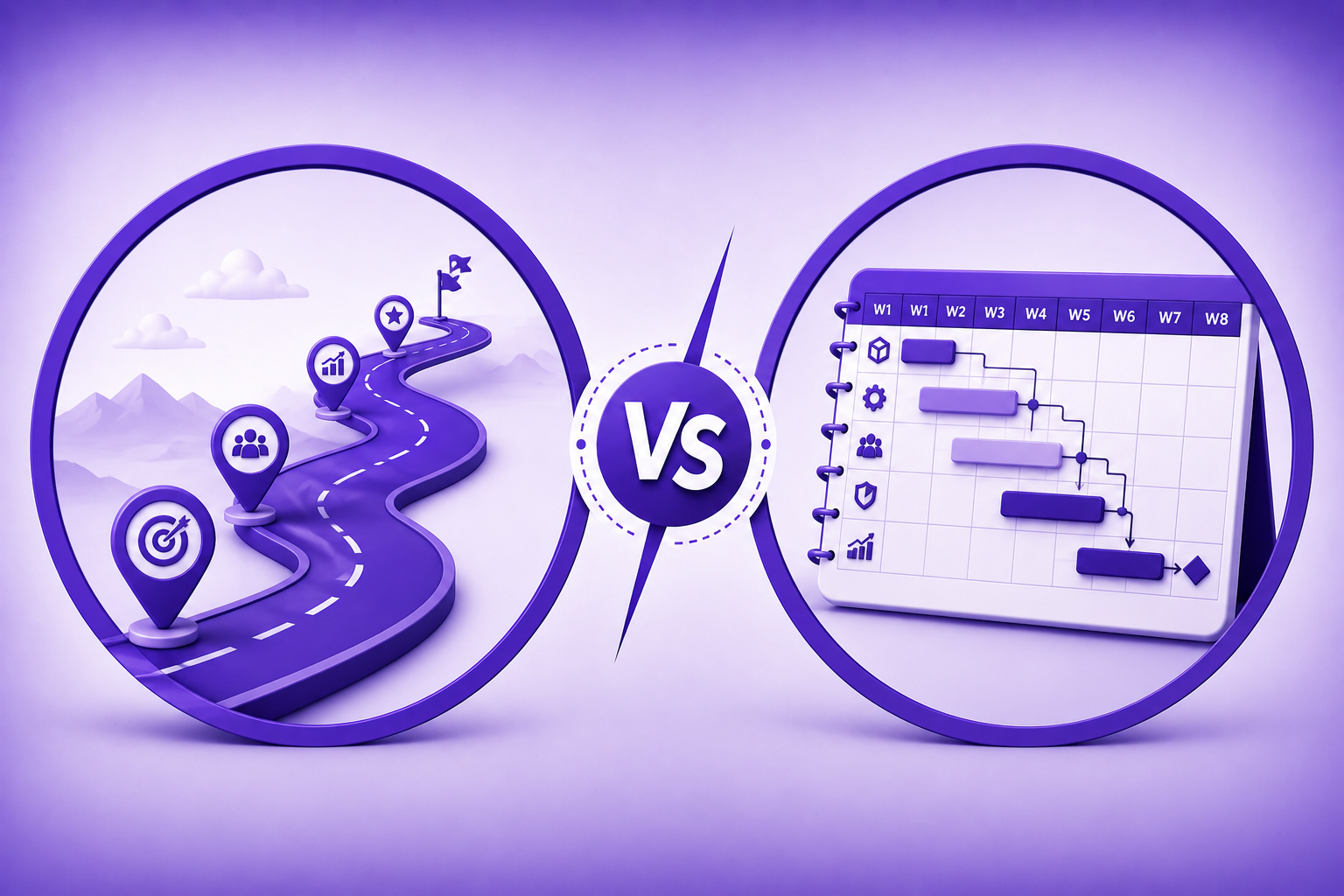
The first question is answered using the Program Roadmap.
The second requires the Program Master Schedule.
Many professionals use these terms interchangeably, but they serve fundamentally different purposes. Understanding that distinction is essential for every Program Manager and is a topic frequently tested in the PgMP examination.
So, how do you know which artifact to use, when to use it, and why both are essential for successful program management?
That’s exactly what this article will help you understand.
Here’s what you’ll learn in this article
By the end of this article, you’ll be able to confidently answer questions such as:
Which artifact is created first during the program life cycle?
When should you use a Program Roadmap versus a Program Master Schedule?
Which stakeholders rely on each artifact, and why?
How do these two artifacts work together to support benefits realization?
What are the most common mistakes Program Managers make when using them?
Whether you’re preparing for the PgMP certification or leading enterprise programs, these insights will help you apply the right artifact in the right situation.
Let’s start by understanding why successful programs need both of these artifacts in the first place.
Why Do We Need Both?
Before comparing these two artifacts, it’s important to understand why both exist.
Unlike a project, a program isn’t about delivering a single output. It’s about coordinating multiple projects, teams, vendors, and business functions so they work together to achieve strategic business outcomes.
No single artifact can satisfy everyone’s information needs.
The Program Sponsor wants to understand whether the investment remains aligned with organizational strategy and when business value will begin to materialize.
The Program Manager needs to understand which dependency could delay another project, how resources should be synchronized, which milestones are at risk, and how every component contributes to benefits realization.
Both perspectives are equally important.
That is precisely why organizations use both the Program Roadmap and the Program Master Schedule.
As emphasized in The Standard for Program Management, Fifth Edition, Program Managers continuously align execution with organizational strategy while synchronizing program components, managing dependencies, and ensuring benefits are delivered throughout the program life cycle.
Every Successful Program Starts with a Strategic Question
What business outcomes are we trying to achieve?
Before discussing schedules, activities, or dependencies, the organization first needs clarity on where the program is headed and what value it is expected to deliver. That strategic direction is captured in the Program Roadmap.
Once the destination is clear, the next question naturally follows:
How will we deliver those outcomes, and when will they be achieved?
Answering that question requires a detailed, integrated view of all the projects, milestones, dependencies, and program activities. That’s where the Program Master Schedule comes into play.
Simply put,
The Program Roadmap explains where the program is going.
The Program Master Schedule explains exactly how and when the program will get there.
Both artifacts complement each other, but they serve very different purposes.
The Program Roadmap provides the strategic direction that keeps executives, sponsors, and governance bodies aligned around expected business outcomes and benefits.
The Program Master Schedule translates that strategy into coordinated execution by integrating the schedules of projects, subsidiary programs, benefits transition activities, governance milestones, and key dependencies, enabling the Program Manager and Program Management Team to successfully deliver those outcomes.
A mature Program Manager understands that strategy without execution remains a vision, while execution without strategic direction becomes nothing more than a collection of disconnected projects. Successful programs require both.
What Is a Program Roadmap?
A Program Roadmap is a strategic communication artifact that provides a high-level view of how the program will deliver value over time.
Rather than focusing on detailed activities, the Program Roadmap communicates the program’s strategic direction and its path toward benefits realization. It provides a graphical view of major milestones, governance decision points, and their logical sequence over time, enabling stakeholders to quickly understand where the program is headed, how value will be delivered, and whether it remains aligned with its strategic objectives.
Its purpose is not to manage execution.
Its purpose is to communicate strategy, maintain organizational alignment, and help stakeholders understand how the program will deliver business value.
Think of it as the executive view of the program.
What Is a Program Master Schedule?
Once the strategic direction is clear, the Program Manager begins translating that strategy into an executable plan.
The Program Master Schedule is the program’s integrated scheduling framework. It brings together approved program activities, major milestones, key dependencies, governance reviews, benefits transition activities, and, as component projects and subsidiary programs are authorized, their schedules into a single coordinated view.
Unlike the roadmap, it supports day-to-day program management.
It enables the Program Manager and Program Management Team to understand how delays in one component affect another, identify the critical path, synchronize shared resources, coordinate major milestones, and proactively manage delivery risks before they impact benefits realization.
Simply put, if the roadmap answers “Where are we going?”, the master schedule answers “How do we get there successfully?”
Which Artifact Is Created First?
This is one of the most common PgMP interview questions.
The answer is straightforward.
The Program Roadmap is created first.
Why?
Because strategy always precedes execution.
During the Program formulation phase, the organization establishes the program vision, strategic objectives, expected benefits, and major capability releases. These are captured within the Program Roadmap.
Only after that strategic direction has been approved does detailed planning begin, resulting in the Program Master Schedule, which integrates schedules across all program components.
Who Uses Which Artifact?
One of the biggest misconceptions among new Program Managers is believing that everyone needs the same information.
In reality, different stakeholders require different levels of detail.
The Program Sponsor primarily uses the Program Roadmap because it provides visibility into strategic objectives, expected business outcomes, benefits realization, and major milestones.
The Program Steering Committee relies on the roadmap to support governance decisions, strategic reviews, and organizational alignment.
The Program Manager depends on both artifacts. The roadmap ensures continuous strategic alignment, while the master schedule enables integration, dependency management, resource synchronization, milestone tracking, and coordinated execution.
The Program Management Team works primarily with the Program Master Schedule to coordinate projects, manage interfaces, analyze schedule impacts, monitor delivery performance, and support benefits transition activities.
Likewise, Project Managers rely heavily on the Program Master Schedule because it provides visibility into integration points, shared resources, cross-project dependencies, and delivery sequencing.
Which Artifact Changes More Frequently?
A mature Program Manager expects the Program Master Schedule to evolve continuously.
Vendor delays occur.
Resources are reassigned.
Dependencies change.
Projects finish earlier or later than planned.
New risks emerge.
The integrated schedule must continually reflect reality.
The Program Roadmap, however, should change only when the program’s strategic direction changes.
Examples include new organizational priorities, revised business objectives, approved scope expansion, significant funding changes, or modifications to expected benefits.
If your roadmap changes every week, your strategy is probably unstable.
If your master schedule never changes, it probably isn’t being actively managed.
How Do These Artifacts Support Benefits Realization?
Although both artifacts contribute to benefits realization, they do so differently.
The Program Roadmap communicates when business capabilities and expected benefits will emerge, helping executives understand the overall value journey.
The Program Master Schedule ensures that every activity necessary to deliver those benefits is completed in the correct sequence, at the appropriate time, and with the required coordination across all program components.
One manages strategic expectations.
The other manages disciplined execution.
Together, they enable successful benefits realization.
Four Mistakes I Frequently See
Over the years, I’ve seen the same mistakes repeated across organizations.
The first is treating the Program Roadmap like a detailed Gantt chart. A roadmap should communicate strategic direction, not thousands of operational activities.
The second is presenting the integrated master schedule to executives who simply need visibility into business outcomes and strategic progress.
The third is failing to update the roadmap after significant changes in organizational strategy, leaving stakeholders aligned to an outdated vision.
The fourth is treating the Program Master Schedule as merely a consolidated project schedule. In reality, it is a program-level management artifact used by the Program Manager to integrate component schedules, manage interdependencies, and coordinate benefits delivery.
PgMP Examination Insight
Whenever a PgMP question refers to strategic alignment, executive communication, benefits realization, business capabilities, or program vision, think Program Roadmap.
Whenever the question refers to integrated scheduling, dependency management, schedule synchronization, critical path, cross-project coordination, or execution monitoring, think Program Master Schedule.
Recognizing these keywords often allows you to eliminate incorrect options immediately.
Final Comparison
Attribute
Program Roadmap
Program Master Schedule
Primary Purpose
Strategic alignment
Execution management
Primary Audience
Program Sponsor, Steering Committee
Program Manager, Program Management Team
Level of Detail
High-level
Detailed
Primary Focus
Business outcomes and strategic direction
Activities, milestones, dependencies, and execution
Program Life Cycle Stage
Developed during Program Formulation and refined during Program Planning
Developed during Program Planning and continuously updated throughout Program Delivery
Maintenance
Updated when strategic changes occur(e.g., business priorities, benefits, funding)
Updated when tactical changes occur((e.g., dependencies, resource constraints, work sequencing)
Time Horizon
Months, quarters, and years
Days, weeks, and months
Shows Dependencies
Major strategic dependencies
Comprehensive cross-project dependencies
Tracks Critical Path
No
Yes
Supports Daily Execution
No
Yes
Supports Benefits Communication
Yes
Indirectly, through execution tracking
Supports Schedule Control
No
Yes
Primary Decision Supported
Are we delivering the right business outcomes?
Are we delivering the work in the right sequence and on time?
I often explain the relationship between these two artifacts in one simple sentence.
The Program Roadmap explains where the program is going.
The Program Master Schedule explains exactly how and when the program will get there.
Neither artifact is more important than the other.
The roadmap keeps the organization aligned around strategy, expected outcomes, and business value.
The master schedule transforms that strategy into coordinated execution by integrating projects, managing dependencies, synchronizing delivery, and ensuring the promised benefits become reality.
The most effective Program Managers know when to step back and discuss strategic outcomes with executives, and when to dive into the integrated schedule to resolve delivery challenges.
That ability to seamlessly move between strategy and execution is what distinguishes outstanding Program Managers from excellent Project Managers. It is also one of the defining characteristics of successful program leadership.
Test Your Understanding
Before scrolling to the comments, see how many of these you can answer without referring back to the article.
Which artifact would you present to the Program Sponsor during a quarterly governance review, and why?
Which artifact would you use to analyze the impact of a delayed project on multiple dependent projects?
Which artifact is created first during the Program Definition phase?
Why does the Program Roadmap generally remain more stable than the Program Master Schedule?
If organizational strategy changes midway through the program, which artifact should be revisited first?
Can a Program Master Schedule exist without a Program Roadmap? Explain your reasoning.
I’d love to hear your thoughts and experiences. Share your answers in the comments, and let’s continue the conversation on how these two artifacts are used in your organization.