The 20-Minute Debate That Changed the Way Our PgMP Cohort Looked at Program Closure
Last weekend, during one of our live PgMP mentoring sessions, I asked the cohort what I thought was a simple question.
“What’s the difference between Component Transition and Program Transition?”
I expected someone to answer in less than a minute.
Instead, it became one of the most engaging discussions of the entire session.
One participant confidently said,
“Component Transition and Program Transition are essentially the same. Both are about handing over work to Operations.”
Almost immediately, another participant challenged that view.
“No. Component Transition happens during Program Delivery, while Program Transition happens during Program Closure.”
Then another voice joined the conversation.
“If Operations has already accepted all the deliverables, hasn’t the Program already transitioned?”
Within minutes, the session turned into a healthy debate.
Everyone had valid arguments.
Everyone was drawing from their own professional experience.
And that’s exactly what made the discussion so valuable.
By the end of the session, one thing became clear.
The confusion wasn’t about when the transition happens.
The confusion was about what is actually being transitioned.
That single realization completely changed the way everyone looked at this topic.
Since this discussion resonated so strongly with the cohort, I thought it would be worthwhile to share it with the larger PgMP and Program Management community.
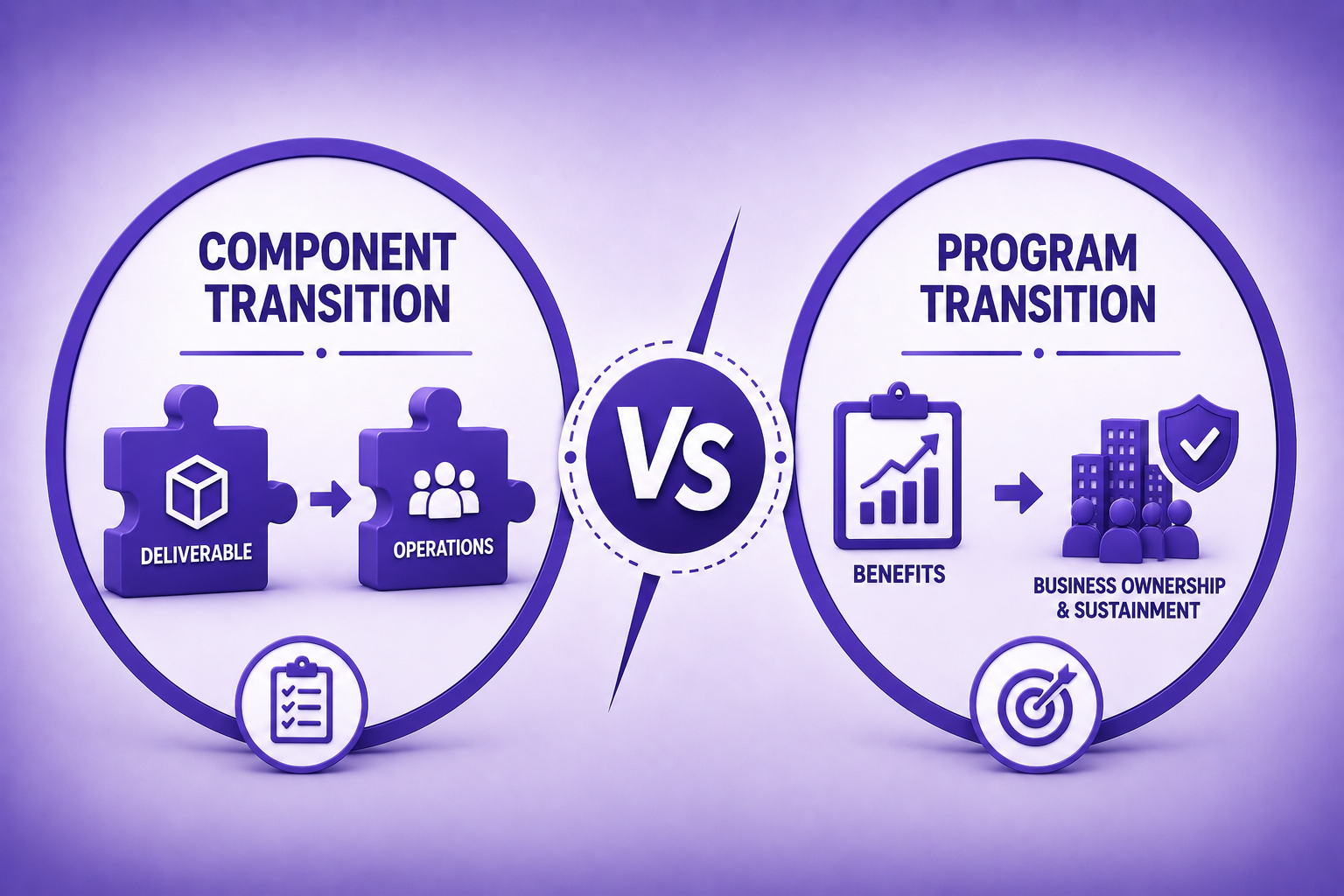
PMI Deliberately Treats Them as Two Different Activities
One of the first things we did during the session was open The Standard for Program Management (Fifth Edition).
The answer was sitting right there in the Program Life Cycle.
PMI doesn’t treat Component Transition and Program Transition as interchangeable terms.
In fact, they appear in two different phases of the Program Life Cycle.
- Component Transition and Closure take place during the Program Delivery phase.
- Program Transition takes place during the Program Closure phase.
That separation is intentional.
Because they serve two completely different purposes.
The Question That Changed the Discussion
Instead of asking,
“When does the transition happen?”
we started asking,
“What exactly is being transitioned?”
Suddenly, everything became much clearer.
Understanding Component Transition
Imagine your organization is executing a Digital Banking Program.
The program consists of several projects.
- Mobile Banking Application
- Internet Banking Platform
- Fraud Detection System
- Customer Authentication Solution
The Mobile Banking project completes first.
The application is deployed.
Users are trained.
Production support documentation is complete.
The Operations team formally accepts responsibility for running the application.
Has something been transitioned?
Absolutely.
The project has successfully transitioned its capability to Operations.
This is Component Transition.
Notice something important.
The overall program hasn’t finished.
Other projects are still underway.
Benefits are still emerging.
Dependencies are still being managed.
The Program Manager is still actively leading the program.
In other words…
A component can transition successfully while the program continues.
So What Is Program Transition?
This is where the discussion became even more interesting.
One participant asked,
“If every component has already transitioned successfully, what’s left to transition?”
That’s a brilliant question.
Because Program Transition is not another technical handover.
It is the transition of the program itself.
By the time Program Transition occurs…
The organization is no longer asking,
“Can we operate this solution?”
Instead, it is asking,
“Can we continue realizing the intended benefits without the Program Team?”
That is a completely different question.
Think Beyond Deliverables
Projects deliver products.
Programs deliver strategic value.
A project may successfully hand over a CRM system.
A Program Manager wants to know whether that CRM system is actually improving customer retention, increasing sales productivity, and delivering the business benefits that justified the investment.
Those benefits don’t automatically appear because the software has gone live.
Someone within the business must now own them.
That ownership is established during Program Transition.
The Simplest Way to Remember It
| Component Transition | Program Transition |
|---|---|
| Occurs during Program Delivery | Occurs during Program Closure |
| Focuses on individual project outputs and capabilities | Focuses on sustaining program benefits and organizational value |
| Receiving team accepts operational responsibility for a component | Business assumes ownership of ongoing benefits and value realization |
| Technical and operational readiness | Strategic and business readiness |
Here’s the Trap PMI Likes to Set
Imagine this PgMP exam scenario.
Every project within the program has been completed successfully.
All deliverables have been accepted.
Training has been completed.
Support teams have taken over.
The sponsor now recommends closing the program immediately.
Would you agree?
A Project Manager might.
A Program Manager pauses.
Before recommending Program Closure, the Program Manager asks questions such as:
- Have benefit owners formally accepted responsibility?
- Is governance for ongoing benefits established?
- Can Operations sustain the new capabilities?
- Has the organization accepted ownership of long-term value realization?
Those questions belong to Program Transition.
Not Component Transition.
The Insight That Stayed With the Cohort
Toward the end of the discussion, one participant summarized the entire concept in a single sentence.
“Component Transition makes the solution operational. Program Transition makes the organization responsible for the value.”
I couldn’t have said it better myself.
My PgMP Exam Tip
Whenever you read a PgMP question, don’t immediately focus on the word transition.
Instead, ask yourself one question.
What is actually being transitioned?
If the scenario is talking about an individual project, its deliverables, or operational capability…
Think Component Transition.
If the scenario is talking about benefits, business ownership, governance, organizational readiness, or sustaining long-term value…
Think Program Transition.
That single distinction can eliminate two incorrect options before you even start evaluating the remaining answers.
Final Thoughts
One of the biggest mindset shifts in becoming a successful Program Manager is realizing that programs are never created simply to deliver projects.
They exist to create lasting organizational value.
Projects may complete.
Deliverables may be accepted.
Components may transition.
But a Program should only transition when the organization is truly prepared to sustain the intended benefits long after the Program Team has stepped away.
And perhaps that’s the simplest way to remember the difference.
Component Transition is about making the solution operational.
Program Transition is about making the value sustainable.
🚀 Ready to Take Your PgMP Journey to the Next Level?
If you’re planning to begin your PgMP certification journey, our live online PgMP mentoring cohort is designed to help you develop exactly this kind of strategic thinking through real-world discussions, case studies, and PMI-aligned mentoring.
Already preparing for the PgMP exam?
Our PgMP Mock Exam Module goes far beyond practice questions. Every scenario is designed to sharpen your decision-making from the PMI Program Management perspective, helping you build the depth of knowledge needed not only to pass the exam but to become a confident and capable Program Manager.
📅 Explore our upcoming PgMP Online Cohort and Mock Exam Module through the link below. We’d be delighted to be part of your PgMP success journey.
https://www.addonskills.com/certifications/pgmp
To your success.
Leave a Reply