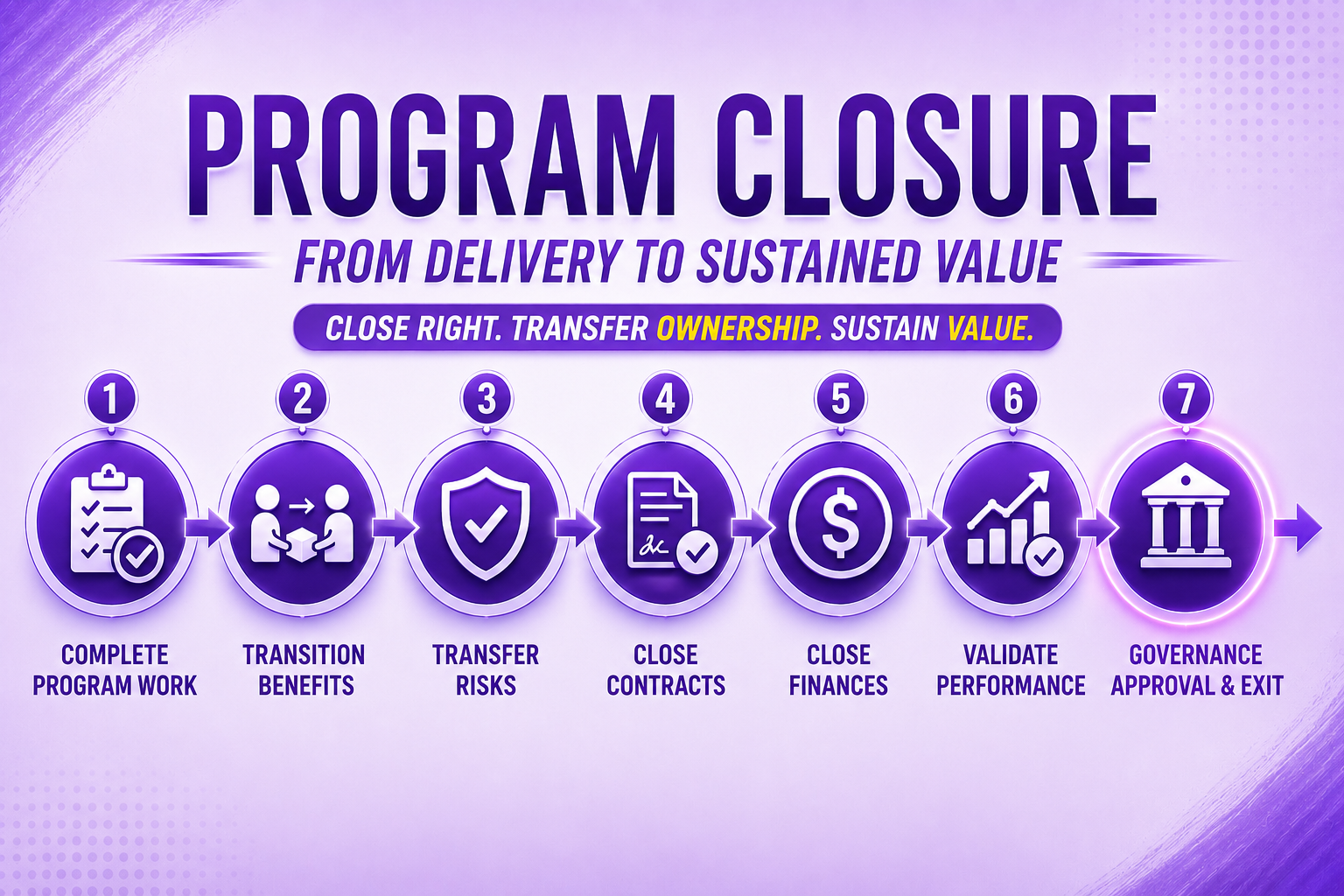
Program closure sounds simple on paper. Projects are done, deliverables are accepted, and you move on. But that’s exactly where most PgMP aspirants slip.
Because in PMI’s world, a program is not successful when outputs are delivered. It is successful when benefits are sustained in operations.
This article will help you lock the concept for both exam readiness and real-world execution.
Why Program Closure Feels Confusing
PMI doesn’t give you a neat checklist. Instead, closure is spread across:
- Program Life Cycle (closure, reporting, transition)
- Benefits Management (sustainment)
- Governance (approval and oversight)
That’s why many professionals mix up:
- Component closure vs Program closure
- Benefits realization vs Benefits transition
- Administrative closure vs Governance closure
And that confusion shows up directly in the exam.
The Real Meaning of Program Closure
Let’s simplify it.
Program closure is not about finishing work.
It’s about transferring accountability.
👉 From program → to operations
👉 From temporary governance → to business-as-usual ownership
👉 From delivery → to sustained value
If this transfer is incomplete, the program is not ready to close. Period.
The 3-Layer Closure Model (This is your mental framework)
Instead of memorizing steps, think in three layers.
🔹 Layer 1: Are we truly ready to close?
This is where most mistakes happen.
Before even thinking about closure approval, you must ensure:
👉 Component closure is complete
- All projects and sub-programs are formally closed
- Deliverables are accepted by relevant stakeholders
- Scope is fully verified with no pending work
- Project-level administrative closure is completed
👉 Benefits are ready for sustainment
- Not just realized, but owned by operations
- KPIs and measurement mechanisms defined
- Accountability clearly transferred
👉 Residual risks are transferred
- Risks are not eliminated, they are reassigned
- Operations has accepted ownership
👉 Contract closure is completed
- All vendor and supplier contracts are formally closed
- Deliverables verified against contractual terms
- Claims, disputes, and obligations are fully resolved
- No pending legal or commercial exposure remains
👉 Financial closure is completed
- All invoices are processed and payments completed
- Budget is reconciled against actuals
- Financial performance is finalized and documented
- No outstanding financial liabilities remain
💡 Sequence matters here:
Contracts are closed first, which defines final obligations, followed by financial closure to settle and reconcile all payments.
💡 If even one of these is incomplete, the program is still active.
🔹 Layer 2: Can you prove program success?
Now comes validation.
👉 Final Program Performance Report
- Planned vs actual across benefits, cost, schedule, and risks
- This becomes the basis for governance closure decision
👉 Stakeholder and customer confirmation
- This is NOT about deliverables being accepted
- It is about confirming that the program’s intended business value is achieved or is ready to be sustained in operations
- Stakeholders should agree that outcomes are meaningful, measurable, and aligned with business expectations
👉 Lessons learned captured
- This is not a documentation exercise, it is organizational learning
Focus on capturing insights at the program level, such as:
- What integration challenges occurred across projects?
- Which benefits were harder to realize and why?
- What governance decisions helped or delayed value delivery?
- Where did stakeholder alignment break down or improve?
- How effective were transition and sustainment strategies?
Also ensure:
- Insights are consolidated, not scattered across projects
- Lessons are categorized into actionable themes (governance, benefits, risk, stakeholder, etc.)
- Knowledge is stored in a central repository for reuse
💡 Strong program managers don’t just close programs.
They improve how future programs are run.
🔹 Layer 3: Formal closure and exit
Only after Layers 1 and 2 are complete:
👉 Governance closure approval
- Formal decision by sponsor, steering committee, or governance board
- Based on evidence, not assumption
Ensure the following are presented clearly:
- Final program performance report (benefits, cost, schedule, risks)
- Status of benefits transition and sustainment readiness
- Confirmation of residual risk and issue ownership transfer
- Summary of stakeholder acceptance at program level
What governance is really validating:
- Has the program delivered intended value?
- Is the business ready to sustain that value without program support?
- Are there any remaining dependencies that require program oversight?
💡 Important distinction:
Governance does not just “approve closure”
It confirms that the program is no longer needed for value realization
👉 Administrative closure
- This is execution after approval, not a decision point
Includes activities such as:
- Archiving all program documents, reports, and records
- Closing program management systems (PMIS, dashboards, repositories)
- Finalizing legal, compliance, and audit-related documentation
- Communicating formal program closure to all stakeholders
Also ensure:
- All knowledge assets are properly stored and accessible
- Documentation supports future audits and organizational learning
- No critical information is left with individuals or informal channels
💡 Key insight:
Administrative closure ensures that nothing from the program is lost, incomplete, or inaccessible after closure
👉 Resource release
- Program team is formally released
- Any temporary structures are dissolved
- No remaining program-level accountability
💡 Resource release before approval is a classic exam trap.
The Golden Sequence (Memorize this logic, not steps)
Here’s the flow that will solve most PgMP questions:
👉 Component Closure
→ Benefits Transition Ready
→ Risks Transferred
→ Final Performance Reporting
→ Governance Approval
→ Administrative Closure
→ Resource Release
Where Most Professionals Go Wrong
Let’s call out the exact traps.
❌ “All projects are closed, so the program is done”
No. That’s only the starting point.
❌ “Benefits have started, we can close”
No. Benefits must be sustainable and owned.
❌ “We can close now and finish transition later”
No. Closure means nothing critical is pending.
❌ “Final reporting can happen after closure”
No. Reporting is needed before governance approval.
❌ “Risks can be handled after closure”
No. If risk ownership is still with the program, closure is invalid.
Real-World Perspective (Why This Matters Beyond Exam)
In real organizations, premature closure leads to:
- Benefits collapsing after program ends
- Operations struggling without ownership clarity
- Risks resurfacing with no accountability
- Leadership losing trust in program governance
Strong program managers don’t just deliver outcomes. They ensure those outcomes survive without them.
One Line You Should Never Forget
👉 A program is ready to close only when benefits, risks, and ownership are fully transitioned, and performance is formally validated under governance.
That’s all in this article. Once again, thank you for being part of this newsletter series. I kindly ask for your continued support. Liking, sharing, and subscribing to this newsletter series is a simple yet powerful way to show your appreciation. By doing so, you not only help me reach a wider audience but also contribute to building a thriving community of knowledge seekers and enthusiasts.
With heartfelt gratitude,
Leave a Reply