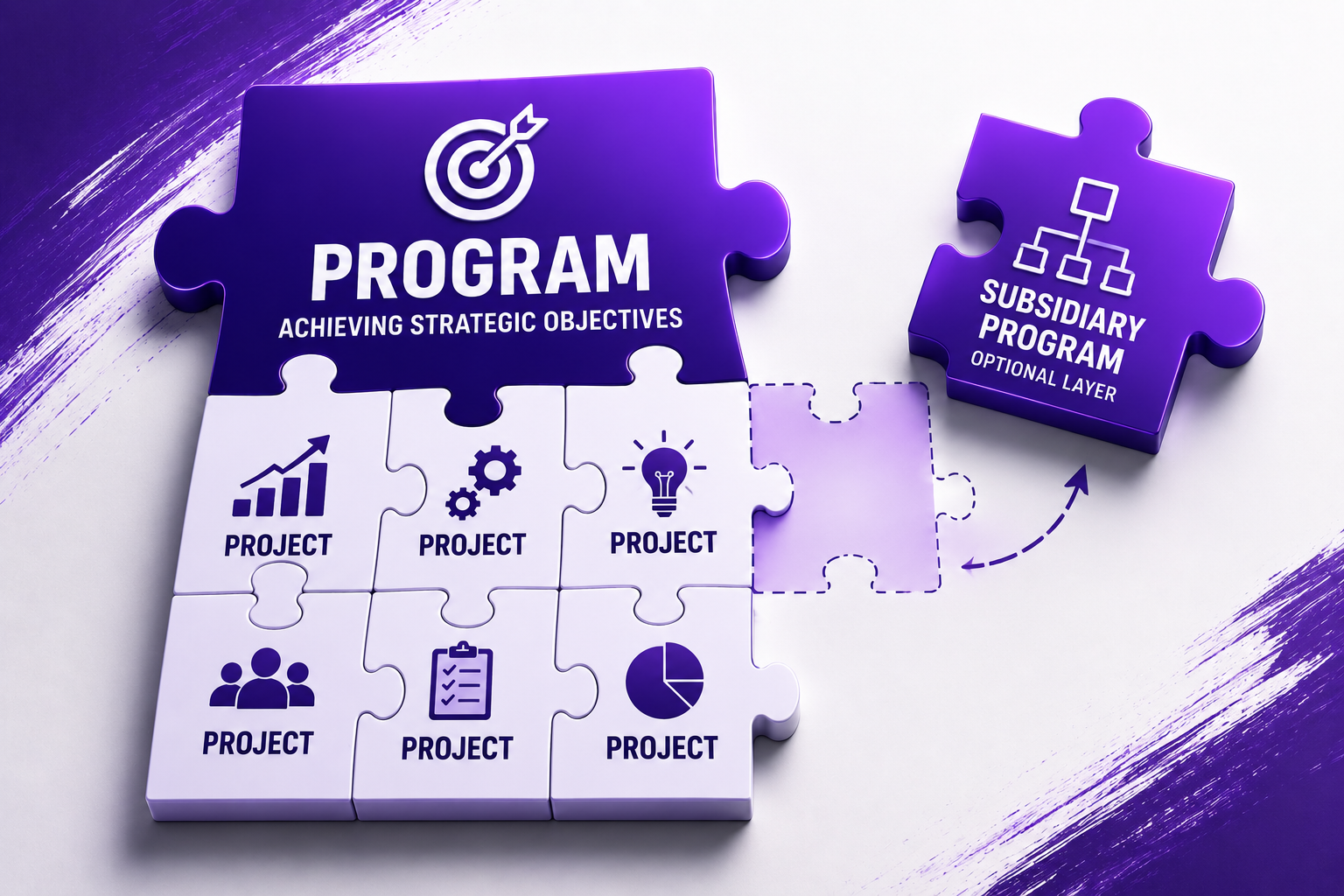
One of the most frequently misunderstood concepts in program management is the relationship between programs, subsidiary programs, and projects.
Many professionals assume that because subsidiary programs are often depicted within program structures, they are a mandatory component of every program. In reality, the opposite is true.
A program may exist without a subsidiary program. However, it cannot exist without projects.
Understanding this distinction is critical not only for PgMP aspirants but also for practicing Program Managers responsible for designing and governing complex initiatives.
Let’s Explore a Real-World Example
Consider a bank launching a Digital Banking Transformation Program.
The program is established to realize strategic benefits such as:
• Increased digital customer adoption • Improved customer experience • Reduced operating costs • Enhanced operational efficiency • Strengthened cybersecurity posture
To achieve these outcomes, the organization initiates several projects, including:
• Mobile banking platform modernization • Digital customer onboarding implementation • Cybersecurity enhancement initiative • AI-powered customer support deployment
Each project delivers specific outputs and capabilities. Collectively, these outputs contribute to the realization of the program’s intended benefits.
Without these projects, there would be no deliverables, no capabilities, and ultimately no benefits to realize.
This is why projects are fundamental building blocks of a program.
When Does a Subsidiary Program Become Necessary?
Now imagine that one particular benefit area, customer experience transformation, grows significantly in scope and strategic importance.
The organization recognizes that improving customer experience requires:
• Dedicated governance structures • Specialized stakeholder engagement efforts • Independent benefits tracking and realization • Coordinated management of multiple related projects • A separate transformation roadmap
At this stage, managing the customer experience initiative as a collection of isolated projects may no longer be sufficient.
The organization may decide to establish a subsidiary program focused specifically on Customer Experience Transformation.
This subsidiary program remains aligned with the parent Digital Banking Transformation Program while managing its own projects, stakeholders, risks, governance mechanisms, and benefits realization activities.
Notice what changed.
The original program did not require a subsidiary program at inception. The subsidiary program emerged only when a subset of strategic benefits justified its creation.
The Key Principle
Projects are created to deliver outputs and capabilities.
Programs are created to realize benefits from those capabilities.
Subsidiary programs are created only when a portion of the program becomes sufficiently large, complex, or strategically significant to warrant dedicated program-level governance and management.
Therefore:
Projects are mandatory because benefits cannot be realized without the outputs they produce.
Subsidiary programs are optional because they are merely a structural mechanism used to manage complexity when needed.
Why This Matters for Program Managers
Experienced Program Managers do not design program structures based on organizational charts or reporting lines.
They design programs based on benefits realization.
The central question is never:
“Do we need a subsidiary program?”
Instead, the question should be:
“Does this collection of benefits require dedicated program-level coordination and governance to maximize value realization?”
When benefits drive the design, the structure naturally follows.
A Valuable PgMP Examination Insight
Many PgMP exam questions test a candidate’s ability to distinguish between governance structures and value-delivery mechanisms.
Remember this simple rule:
A program can survive without subsidiary programs.
A program cannot survive without projects.
Projects create outputs.
Outputs enable capabilities.
Capabilities generate benefits.
Benefits justify the existence of the program.
Understanding this chain of value creation is essential for both PgMP success and effective program leadership.
The best Program Managers don’t focus on organizational structures first. They focus on benefits realization and then build the governance framework necessary to achieve it.
That’s all in this article. Once again, thank you for being part of this newsletter series. I kindly ask for your continued support. Liking, sharing, and subscribing to this newsletter series is a simple yet powerful way to show your appreciation. By doing so, you not only help me reach a wider audience but also contribute to building a thriving community of knowledge seekers and enthusiasts.
With heartfelt gratitude,
Leave a Reply