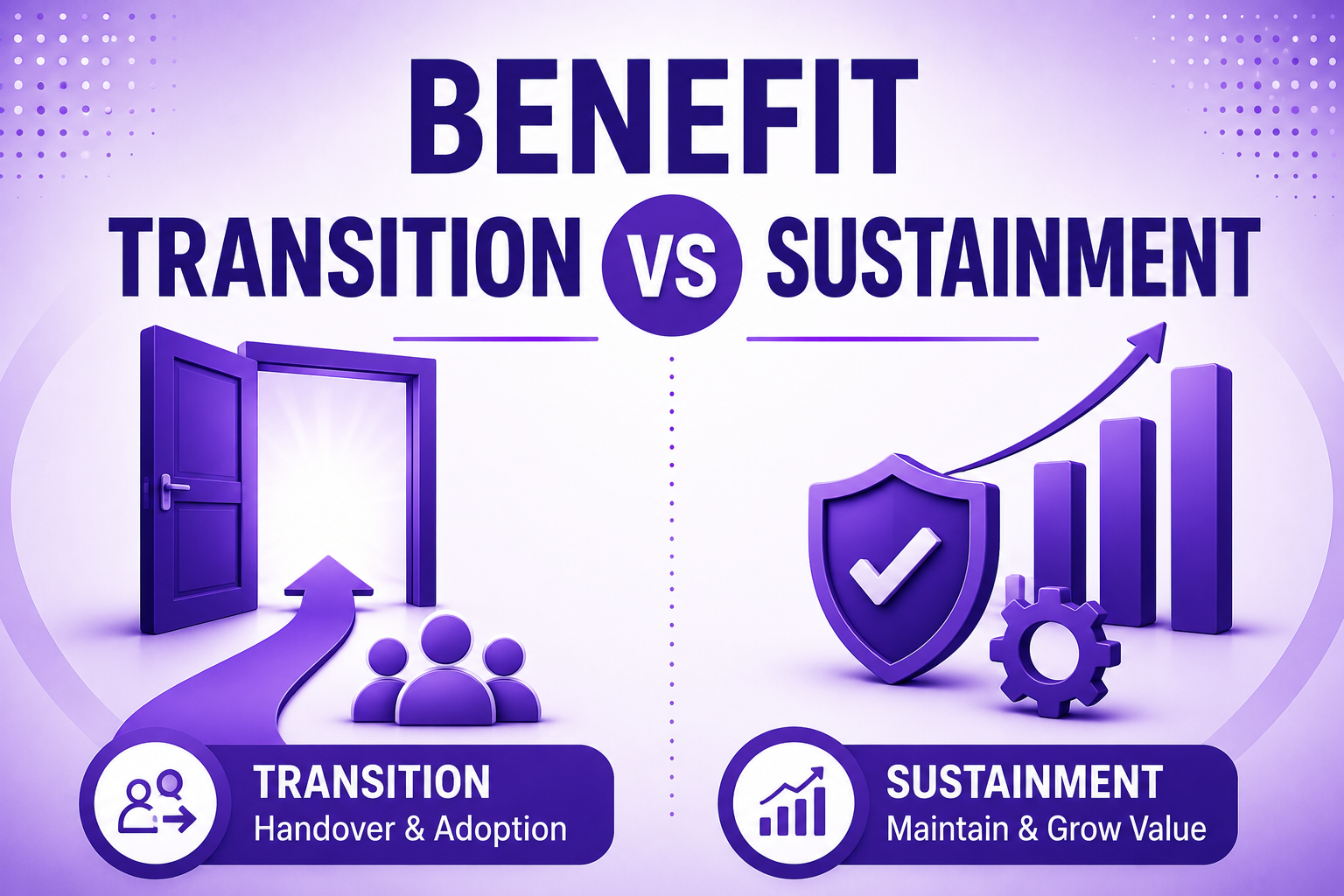
Completing the deliverables doesn't complete the program. Transitioning and sustaining the benefits does.
Imagine you are the Program Manager for Green Horizon Township, a premium residential township developed under a Build-Operate-Transfer (BOT) model.
The program delivers:
🏢 Eight residential towers
🏥 200-bed hospital
🏫 Secondary school
🏡 Clubhouse
🛍️ Shopping complex
🏟️ Sports arena
🌳 Community park
🏛️ Civic centre
After several years of execution, every component has been successfully completed.
Construction is over.
Quality inspections have been signed off.
Occupancy certificates have been obtained.
At this stage, many professionals would confidently say,
“The program is complete.”
Not quite.
From a PgMP perspective, completing the construction is only the beginning of realizing benefits.
The next question every Program Manager should ask is:
“Is the organization ready to take ownership of these benefits, and can those benefits continue delivering value for years to come?”
The answer to these two questions explains one of the most frequently tested concepts in the PgMP examination: Benefit Transition and Benefit Sustainment.
🔄 Benefit Transition
“Can the receiving organization now take ownership of the delivered benefits?”
Once the township satisfies its acceptance criteria, the Program Manager executes Benefit Transition.
Benefit Transition is not simply a planning activity.
It is the actual handover of the completed capability to the organization that will operate it.
Typical transition activities include:
✅ Operational readiness assessment
✅ Acceptance verification
✅ Training operational staff
✅ Transfer of manuals and documentation
✅ Warranty transfer
✅ Municipal approvals
✅ Residual risk transfer
✅ Formal handover and acceptance
Benefit Transition = Executing the transfer of the delivered capability to the receiving organization so benefits can be sustained.
👨💼 Program Manager’s Responsibilities
✔ Verify benefit realization criteria have been achieved.
✔ Confirm operational readiness.
✔ Coordinate handover across all program components.
✔ Ensure documentation, contracts, training, and risks are transferred.
✔ Obtain formal acceptance from the receiving organization.
🌱 Benefit Sustainment
“Can the organization continue realizing these benefits for years to come?”
After successful transition, residents begin occupying Green Horizon Township.
The township is now operated through Operations Portfolio, which performs:
🏢 Building maintenance
🧹 Housekeeping
🛡️ Security
🌳 Landscaping
⚡ Utility management
😊 Customer satisfaction monitoring
These are Benefit Sustainment activities.
The Program Manager doesn’t run day-to-day operations.
Instead, the Program Manager ensures, before program closure, that the receiving organization is fully prepared to sustain the benefits.
👨💼 Program Manager’s Responsibilities
✔ Develop the Benefits Sustainment Plan.
✔ Define operational KPIs.
✔ Identify sustainment risks.
✔ Assign benefit ownership.
✔ Ensure the receiving organization is capable of sustaining the benefits.
💎 Benefit vs Business Value
Another concept frequently confused in the PgMP exam is the difference between Benefits and Business Value.
For Green Horizon Township:
Benefits
Once the township becomes operational:
🏥 Patients receive healthcare.
🏫 Students attend school.
🏢 Residents occupy their homes.
🛍️ Businesses begin serving customers.
These are benefits being realized.
Business Value
As these benefits continue over time, the organization begins achieving its strategic objectives.
For example:
📈 Increased property appreciation
💰 Sustainable rental and commercial revenue
😊 Higher resident satisfaction
🏆 Enhanced brand reputation
📊 Better return on investment
🎯 Long-term strategic growth
These outcomes represent the business value created through sustained benefit realization.
Benefits answer: “What positive outcome has been achieved?”
Business Value answers: “How do those outcomes help achieve the organization’s strategic objectives?”
Understanding the difference between Benefits and Business Value explains what the Program Manager is trying to achieve.
The next question is equally important…
When should the Program Manager start preparing for Benefit Transition and Benefit Sustainment?
The answer is much earlier than most PgMP aspirants expect.
📅 When are these plans prepared?
This is where many PgMP aspirants get confused.
The Benefits Transition Plan and Benefits Sustainment Plan are developed and progressively refined during the Program Delivery Phase as components mature and approach operational readiness.
They are executed only when the delivered capability is ready for transition.
If the program delivers incremental benefits, there may be:
🔹 Multiple Benefit Transition Plans
🔹 Multiple Benefit Sustainment Plans
🔹 Multiple transition events
Each completed capability can have its own transition event and corresponding sustainment activities. PMI explicitly recognizes that there may be multiple transition events as individual program components close and that incremental benefits may be transitioned before the overall program ends.
📊 Benefit Transition vs Benefit Sustainment
| Benefit Transition | Benefit Sustainment |
|---|---|
| Transfers ownership | Maintains business value |
| Executed after a capability is completed | Continues after transition and often after program closure |
| Program Manager leads the transition | Receiving organization performs the sustainment |
| Focuses on acceptance and operational readiness | Focuses on ongoing operational performance |
| Tactical execution using transition checklists | Operational execution using sustainment processes |
🎯 PgMP Exam Nuggets
💡 Transition is about “Readiness.”
💡 Sustainment is about “Continuity.”
💡 The Program Manager owns the transition but not the day-to-day operations.
💡 A Transition Plan is prepared before handover. The handover itself is the Benefit Transition.
💡 A Sustainment Plan is prepared before program closure, but sustainment activities continue after transition and frequently after program closure.
💡 Programs delivering incremental benefits can have multiple transition plans, multiple sustainment plans, and multiple transition events.
Remember this one line for the PgMP exam:
Benefit Transition delivers ownership. Benefit Sustainment preserves value.
Leave a Reply